Summary
A WordPress website can look attractive while still having serious technical, SEO, security, performance or conversion problems underneath.
Broken links, poor Core Web Vitals, indexing errors, outdated plugins, security vulnerabilities, duplicate content, incorrect redirects, missing metadata, poor mobile usability and weak internal linking can all affect the quality and discoverability of a website.
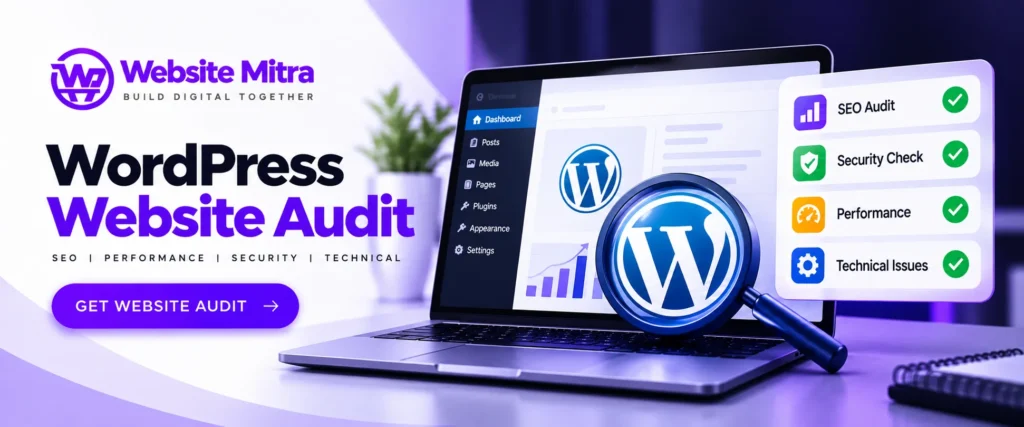
A WordPress website audit service in India provides a structured examination of a website to identify these problems and create a practical roadmap for fixing them.
A comprehensive audit can evaluate:
- Technical SEO
- Website performance
- Core Web Vitals
- WordPress configuration
- Mobile responsiveness
- Security
- Plugins and themes
- Website structure
- On-page SEO
- Content
- Internal links
- Broken links
- Indexing
- XML sitemap
- Robots.txt
- Schema markup
- Accessibility
- User experience
- Conversion opportunities
- WooCommerce functionality
- Website health
WebsiteMitra offers website audit and SEO services for businesses in Hinjewadi, Pune, Maharashtra and across India. Its published audit services cover technical, security, SEO, accessibility and content-related checks.
This guide explains what a WordPress website audit includes, why it matters, how the process works, what businesses should look for in an audit report, pricing considerations and how to turn audit findings into measurable improvements.
Introduction
Having a WordPress website is only the beginning of building a successful online presence.
A business may invest significantly in website design, content, development and SEO but still struggle to generate traffic, enquiries or sales.
One reason can be hidden website problems.
For example, imagine a website with:
- A beautiful homepage
- Professional branding
- Excellent services
- High-quality content
But the website also has:
- Slow loading pages
- Broken internal links
- Incorrect canonical tags
- Important pages accidentally marked noindex
- Poor mobile experience
- Outdated plugins
- Missing structured data
- Unoptimized images
- Security weaknesses
- Poor conversion paths
The website may look fine to a visitor while technical problems remain invisible.
This is where a WordPress website audit service India becomes useful.
A website audit is essentially a health check for your digital presence.
Instead of guessing why a website is underperforming, an audit creates a structured picture of what is working, what is broken, what should be improved and which issues deserve priority.
Google’s Search Essentials explain that websites need to meet basic technical requirements, follow spam policies and implement search-friendly best practices. Google also emphasizes helpful, reliable, people-first content rather than tactics designed simply to manipulate rankings.
What Is a WordPress Website Audit?
A WordPress website audit is a systematic analysis of a WordPress website’s technical health, SEO, security, performance, content, usability and functionality.
The objective isn’t simply to generate a list of errors.
A useful audit should answer four questions:
1. What is wrong?
Identify existing issues.
2. Why does the issue matter?
Explain its potential effect on users, search engines or business operations.
3. How serious is it?
Prioritize issues according to their impact.
4. How should it be fixed?
Provide practical recommendations or implementation steps.
This makes an audit much more useful than a generic automated website score.
Why Is a WordPress Website Audit Important?
A website can gradually develop problems as it grows.
You may install new plugins, add pages, change URLs, modify templates, publish content, migrate hosting or add third-party integrations.
Over time, these changes can create technical issues.
A regular audit can identify problems before they become larger business problems.
Common examples:
Slow website → poor user experience
Broken contact form → lost enquiries
Broken checkout → lost sales
Noindex mistake → important page excluded from search
Broken links → poor navigation
Outdated plugin → compatibility/security concern
Incorrect redirects → crawling and user experience problems
Poor mobile design → difficult browsing
Weak internal linking → important content may be harder to discover
What Does a Professional WordPress Website Audit Include?
A comprehensive audit should look beyond basic page speed.
WebsiteMitra’s published website audit service describes six major audit areas: technical, security, SEO, accessibility, content and compliance-related checks.
For a WordPress website, these can be expanded into the following areas.
1. Technical SEO Audit
Technical SEO determines whether search engines can effectively access, crawl, understand and index your website.
A technical audit may examine:
- Crawlability
- Indexability
- HTTP status codes
- Robots.txt
- XML sitemap
- Canonical URLs
- Redirects
- 404 errors
- Internal links
- URL structure
- HTTPS
- Mobile usability
- JavaScript rendering
- Duplicate URLs
- Pagination
- Orphan pages
Google’s technical requirements state that Googlebot must be able to access a page, the page should work successfully and it must contain indexable content to be eligible for indexing. However, meeting these minimum requirements does not guarantee that a page will be indexed.
2. WordPress SEO Audit
A WordPress SEO audit examines whether the website has been configured properly for search visibility.
The audit can review:
Title Tags
Every important page should have an appropriate and descriptive title.
Meta Descriptions
Meta descriptions should accurately summarize page content and encourage relevant searchers to understand the page.
Headings
The audit can review:
- H1
- H2
- H3
- Heading hierarchy
- Missing headings
- Over-optimized headings
URLs
SEO-friendly URLs should be:
- Descriptive
- Understandable
- Relevant
- Consistent
Internal Linking
Internal links help users navigate between related pages and help search engines discover content.
Image SEO
Images can be checked for:
- File size
- Alt text
- Dimensions
- File names
- Compression
- Modern formats
3. Website Speed Audit
Website speed is one of the most important areas of a modern website audit.
A speed audit can examine:
- Server response time
- Page loading
- Image optimization
- CSS
- JavaScript
- Caching
- CDN
- Font loading
- Third-party scripts
- Database performance
- Plugin impact
- Render-blocking resources
WebsiteMitra’s published WordPress performance service includes areas such as image optimization, CSS/JavaScript optimization, database optimization, caching and plugin auditing.
A speed audit should not simply say:
“Your website is slow.”
It should identify why it is slow and what can be changed.
4. Core Web Vitals Audit
Core Web Vitals are an important part of modern website performance evaluation.
The current Core Web Vitals are:
- LCP — Largest Contentful Paint
- INP — Interaction to Next Paint
- CLS — Cumulative Layout Shift
Google’s guidance currently identifies good thresholds of approximately:
- LCP: 2.5 seconds or less
- INP: less than 200 milliseconds
- CLS: less than 0.1
These metrics measure different aspects of loading, responsiveness and visual stability.
An audit can identify whether performance problems are related to:
- Large images
- Heavy JavaScript
- Slow servers
- Poor caching
- Third-party scripts
- Layout shifts
- Font loading
- Theme architecture
5. WordPress Security Audit
Security is another major component of a professional WordPress website audit.
The audit can review:
- WordPress version
- Plugin versions
- Theme versions
- Vulnerable components
- SSL/TLS
- Security headers
- User accounts
- Administrator privileges
- Login security
- Malware indicators
- File changes
- Backup configuration
- Database security
- Server configuration
WebsiteMitra’s published audit service includes SSL/TLS implementation, vulnerabilities and malware, security headers, authentication, data protection, backup/disaster recovery and plugin/theme vulnerabilities.
6. Plugin and Theme Audit
One of the advantages of WordPress is its ecosystem of plugins and themes.
But plugins can also create maintenance and compatibility challenges.
A plugin audit can identify:
- Outdated plugins
- Unused plugins
- Duplicate functionality
- Poorly maintained plugins
- Heavy plugins
- Plugin conflicts
- Security vulnerabilities
- Unnecessary scripts
Themes should similarly be reviewed for:
- Updates
- Custom code
- Child-theme usage
- Unused features
- Performance
- Compatibility
- Accessibility
The objective isn’t necessarily to remove every plugin.
The objective is to determine whether every important plugin has a legitimate role.
7. Mobile Responsiveness Audit
A website should work across different screen sizes.
A mobile audit checks:
- Navigation
- Buttons
- Forms
- Typography
- Images
- Tables
- Popups
- Headers
- Footers
- Checkout
- Touch interactions
A page that works perfectly on a desktop monitor can still provide a poor experience on a mobile phone.
This is especially important for local businesses because customers frequently discover services through mobile devices.
8. Website Accessibility Audit
Accessibility helps make websites usable by people with different abilities.
An accessibility audit can review:
- Keyboard navigation
- Alternative text
- Color contrast
- Form labels
- Heading structure
- Focus states
- Screen-reader compatibility
- Link descriptions
- Accessible controls
WebsiteMitra’s published audit service specifically lists keyboard navigation, screen-reader compatibility, color contrast and alternative text among accessibility checks.
9. Content Audit
Technical optimization alone isn’t enough.
Content should also be reviewed.
A content audit can identify:
- Thin content
- Outdated information
- Duplicate content
- Missing topics
- Poor search intent alignment
- Keyword cannibalization
- Weak introductions
- Poor headings
- Missing supporting content
- Inaccurate information
- Pages with little business value
Google’s Search Essentials emphasize creating helpful and reliable, people-first content.
10. On-Page SEO Audit
An on-page SEO audit can evaluate:
- Primary keyword targeting
- Search intent
- Title tags
- Meta descriptions
- Headings
- Content structure
- Internal links
- Image alt text
- URLs
- Content depth
- Topic coverage
- Entity relevance
- Calls to action
The goal isn’t to insert the same keyword repeatedly.
Instead, the page should clearly communicate its subject while satisfying the user’s search intent.
11. Website Indexing Audit
One of the most important questions is:
Can Google actually access and index the pages that matter?
An indexing audit checks:
- Indexed pages
- Non-indexed pages
- Noindex directives
- Robots.txt
- Canonical tags
- Sitemap URLs
- Redirected pages
- Duplicate URLs
- Crawl errors
Google recommends using Search Console and URL Inspection to understand how Google sees individual URLs and website indexing.
12. XML Sitemap Audit
An XML sitemap helps communicate important URLs to search engines.
The audit can verify:
- Sitemap accessibility
- Sitemap status
- Correct URLs
- HTTP status codes
- Canonical consistency
- Indexability
- Duplicate URLs
- Unnecessary URLs
A sitemap is not a guarantee that Google will index every URL inside it, but a properly configured sitemap can help search engines discover important pages.
13. Robots.txt Audit
Robots.txt controls crawling instructions.
A mistake here can potentially prevent search engines from crawling important sections.
An audit checks:
- Whether the file exists
- Whether important pages are blocked
- Whether unnecessary areas are blocked
- Sitemap references
- Syntax
- Compatibility with the intended SEO strategy
Google specifically notes that robots.txt controls crawling but isn’t the appropriate mechanism for keeping a page out of Google’s index. For that purpose, appropriate noindex mechanisms should be used.
14. Broken Link Audit
Broken links can create poor experiences.
An audit identifies:
- Internal 404s
- Broken external links
- Incorrect redirects
- Deleted pages
- Incorrect URLs
- Broken media references
The resulting report can classify links according to priority.
For example:
High priority: broken links on important service pages
Medium priority: broken internal links on blog articles
Low priority: old external references with alternatives available
15. Redirect Audit
Redirects are important when URLs change.
A website audit can look for:
- 301 redirects
- 302 redirects
- Redirect chains
- Redirect loops
- Incorrect destinations
- HTTP-to-HTTPS redirects
- WWW/non-WWW consistency
Poorly managed redirects can create unnecessary crawling and usability problems.
16. Canonical URL Audit
Canonical tags help communicate which version of a URL should be considered the preferred version when multiple URLs contain similar or duplicate content.
An audit can identify:
- Missing canonicals
- Self-referencing canonicals
- Incorrect canonicals
- Canonicals pointing to redirects
- Canonicals pointing to non-indexable pages
Canonical configuration should always reflect the site’s actual content architecture.
17. Schema Markup Audit
Structured data helps search engines understand page content and can make pages eligible for certain richer search appearances.
Google explains that structured data can help it understand webpage content and support supported rich-result features.
A schema audit can review:
- Organization
- LocalBusiness
- Article
- BlogPosting
- BreadcrumbList
- Product
- Service
- FAQPage where appropriate
The key requirement is accuracy.
Google states that structured data should represent the visible page content and does not guarantee that a rich result will actually appear.
18. Internal Linking Audit
Internal linking is often overlooked.
An audit can identify:
- Orphan pages
- Important pages with few links
- Excessive links
- Poor anchor text
- Broken internal links
- Missing contextual links
- Weak content clusters
For a business website, internal linking can connect:
Homepage → Service Page → Supporting Blog → Related Service → Contact Page
This creates a logical information architecture for both users and search engines.
19. Conversion Rate Audit
SEO traffic is valuable only when visitors can take meaningful actions.
A conversion audit can examine:
- Contact forms
- Phone numbers
- WhatsApp buttons
- CTAs
- Service pages
- Lead forms
- Navigation
- Trust signals
- Testimonials
- Pricing information
- Contact information
- Checkout
For example, a service page receiving traffic but generating few enquiries may need a conversion review rather than simply more SEO content.
20. WooCommerce Website Audit
E-commerce websites require additional checks.
A WooCommerce audit can review:
- Product pages
- Categories
- Filters
- Cart
- Checkout
- Payment gateways
- Shipping
- Taxes
- Coupons
- Order emails
- Product schema
- Product indexing
- Duplicate product URLs
- Database performance
- WooCommerce extensions
A checkout problem can directly affect revenue, so WooCommerce websites often benefit from deeper functional testing.
What Is the Website Audit Process?
A professional WordPress website audit service India can follow a structured process.
Step 1: Understand the Business
Before technical analysis, understand:
- What the business sells
- Target audience
- Geographic market
- Main services
- Main conversion goals
- Competitors
- Important pages
Step 2: Collect Website Information
The auditor examines:
- Website URL
- Platform
- Hosting
- WordPress configuration
- Search Console data where available
- Analytics data where available
Step 3: Crawl the Website
The website is analyzed to identify technical issues.
Step 4: Analyze Performance
Performance and Core Web Vitals are evaluated.
Step 5: Analyze SEO
On-page and technical SEO issues are identified.
Step 6: Review Security
Plugins, themes, SSL and security configuration are checked.
Step 7: Review UX and Conversion
Important user journeys are evaluated.
Step 8: Prioritize Problems
Not every issue has equal importance.
A useful report can categorize findings as:
Critical → High → Medium → Low
Step 9: Create Action Plan
The report should explain:
- What needs fixing
- Why it matters
- How it should be fixed
- Priority
- Estimated effort
Step 10: Implementation
The business can then implement the recommendations internally or hire the audit provider to complete the fixes.
What Does a WordPress Website Audit Report Contain?
A professional report may include:
Executive Summary
A simple overview of website health.
Technical Findings
Technical problems discovered during crawling.
SEO Findings
On-page and technical SEO recommendations.
Performance Report
Speed and Core Web Vitals observations.
Security Findings
Potential vulnerabilities and security recommendations.
UX Findings
Usability and conversion observations.
Content Recommendations
Content gaps and optimization opportunities.
Priority Roadmap
A clear sequence for implementation.
WebsiteMitra’s current website-health audit offering says its reports include website health findings, AI-readiness assessment, security risks, SEO opportunities and a prioritized action plan, with an executive PDF report.
WebsiteMitra WordPress Website Audit Services
WebsiteMitra provides website audit and SEO services for businesses in Pune and across India.
Its published service covers:
- Technical website audit
- SEO audit
- Security audit
- Accessibility audit
- Content audit
- Website performance
- Mobile responsiveness
- Core Web Vitals
- SSL
- Broken links
- Sitemap
- Robots.txt
- Schema markup
- Indexing
- Internal linking
- Duplicate content
WebsiteMitra also currently describes a broader Website Health & AI Readiness Audit, covering website performance, SEO, security, conversion optimization and AI readiness. The published offering states that it evaluates more than 100 checkpoints and provides a PDF report and priority action roadmap.
Website Audit Pricing in India
Website audit pricing depends on the depth and scope of the audit.
Factors that influence pricing include:
- Website size
- Number of URLs
- WordPress complexity
- WooCommerce
- Custom plugins
- Custom themes
- Traffic
- Security requirements
- SEO requirements
- Competitor analysis
- Conversion analysis
- AI-readiness requirements
WebsiteMitra currently lists three website health/audit packages on its dedicated audit page:
| Package | Published Price | Intended Scope |
|---|---|---|
| Starter Audit | ₹2,999 one-time | Website health, SEO/meta review, Core Web Vitals and PDF report |
| Professional Audit | ₹7,999 one-time | Website health, AI readiness, security, technical SEO, conversion analysis and priority recommendations |
| Business Growth Audit | ₹14,999 one-time | Professional scope plus AI opportunities, competitor benchmarking, lead-generation review and growth strategy |
These prices are published on WebsiteMitra’s current website and can change, so confirm the current scope and pricing before purchasing.
WebsiteMitra’s separate website audit and SEO landing page also lists a ₹1,999 Website Audit package and ₹7,999/month Complete Website SEO service, so prospective customers should confirm which package applies to their requirements.
How Long Does a Website Audit Take?
The time required depends on website size and complexity.
A small business website may be assessed relatively quickly.
A large website with:
- Hundreds of pages
- WooCommerce
- Custom plugins
- Multiple integrations
- Large databases
- International SEO
can require significantly more analysis.
WebsiteMitra’s current audit page says most reports are delivered within 24–72 hours, depending on website size, complexity, integrations and selected package.
Who Needs a WordPress Website Audit?
A website audit can be useful for:
Small Businesses
Identify technical problems before they affect enquiries.
Startups
Build a strong technical foundation.
E-commerce Businesses
Identify checkout, product, performance and SEO issues.
Local Businesses
Improve local search visibility and conversion paths.
Agencies
Audit client websites before beginning SEO or development work.
Bloggers
Identify technical SEO and content problems.
SaaS Businesses
Review performance, architecture and conversion journeys.
Established Businesses
Find problems accumulated over years of website changes.
When Should You Get a WordPress Website Audit?
Consider an audit when:
- Organic traffic drops
- Website becomes slow
- Rankings decline
- Website migration is planned
- Redesign is planned
- New SEO campaign is starting
- Website has been hacked
- Plugins are outdated
- WooCommerce conversion falls
- Pages aren’t indexing
- New domain is launched
- Major URL changes are made
- Website has never been technically reviewed
An audit can also be useful before investing heavily in SEO because it identifies technical obstacles that should be addressed first.
Website Audit vs SEO Audit
These terms overlap but aren’t identical.
| Website Audit | SEO Audit |
|---|---|
| Overall website health | Search visibility |
| Security | Technical SEO |
| Performance | Keywords |
| Mobile usability | On-page SEO |
| Functionality | Content |
| Accessibility | Internal linking |
| UX | Indexing |
| Technical issues | Search performance |
A comprehensive WordPress audit can combine both.
Website Audit vs Website Maintenance
An audit is primarily a diagnosis.
Maintenance is primarily ongoing management.
Audit
Find → Analyze → Prioritize → Recommend
Maintenance
Monitor → Update → Fix → Optimize → Repeat
For many businesses, the two services work well together.
First perform an audit.
Then use the findings to establish an ongoing maintenance and optimization plan.
Common WordPress Problems Found During Website Audits
Some frequently discovered issues include:
- Outdated plugins
- Unused plugins
- Missing alt text
- Broken links
- Slow images
- Poor caching
- Missing metadata
- Incorrect canonical tags
- Indexing problems
- Duplicate content
- Poor internal linking
- Missing sitemap
- Incorrect robots.txt
- Mobile layout problems
- Weak CTAs
- Missing schema
- Security weaknesses
- Poor hosting configuration
- Database bloat
- Broken redirects
Not every issue has the same impact, which is why prioritization is important.
How to Choose the Best WordPress Website Audit Service in India
Rather than choosing an audit provider based only on price, evaluate its process.
Ask:
1. What exactly will be audited?
Request a clear scope.
2. Will I receive a report?
A professional audit should document findings.
3. Will issues be prioritized?
A long list of errors isn’t enough.
4. Can the provider implement fixes?
This can be useful if you don’t have an in-house developer.
5. Does the provider understand WordPress?
WordPress-specific issues require WordPress expertise.
6. Does it understand SEO?
Technical website problems and SEO problems can overlap.
7. Can it handle custom development?
This is important for websites with custom plugins or themes.
8. Are recommendations realistic?
Be cautious about guaranteed first-place Google rankings. Google’s own guidance says that SEO professionals should not promise guaranteed first-place results.
WordPress Website Audit Checklist
Use this checklist before hiring an audit company.
Technical
- Crawlability checked
- Indexability checked
- HTTP status codes checked
- Robots.txt checked
- XML sitemap checked
- Canonicals checked
- Redirects checked
- 404 errors checked
- HTTPS checked
Performance
- Core Web Vitals checked
- LCP reviewed
- INP reviewed
- CLS reviewed
- Images optimized
- Caching reviewed
- JavaScript reviewed
- CSS reviewed
- Server performance reviewed
SEO
- Title tags
- Meta descriptions
- H1/H2 structure
- Internal links
- Keyword targeting
- Search intent
- Duplicate content
- Schema
- Indexing
- Content quality
Security
- WordPress version
- Plugin vulnerabilities
- Theme vulnerabilities
- SSL
- Security headers
- Administrator accounts
- Malware
- Backups
- Authentication
UX
- Mobile responsiveness
- Navigation
- Forms
- CTAs
- Typography
- Accessibility
- Contact information
- Conversion journey
Frequently Asked Questions
1. What is a WordPress website audit service in India?
A WordPress website audit service analyzes a website’s technical health, SEO, performance, security, content, usability and functionality to identify problems and recommend improvements.
2. Why should I audit my WordPress website?
An audit can identify hidden technical, SEO, security, speed and usability problems that may affect visitors, conversions and search visibility.
3. What does a WordPress SEO audit include?
It can include technical SEO, indexing, title tags, meta descriptions, headings, URLs, internal linking, content, keyword targeting, XML sitemap, robots.txt, canonicals and structured data.
4. Does a website audit guarantee higher Google rankings?
No. An audit identifies problems and opportunities, but rankings depend on many factors. Google itself does not guarantee specific rankings or first-place results.
5. Does WebsiteMitra provide WordPress website audits?
Yes. WebsiteMitra publishes website audit and SEO services covering technical, security, SEO, accessibility and content-related checks for businesses in Pune and across India.
6. How much does a WordPress website audit cost in India?
Pricing varies based on website size and audit depth. WebsiteMitra currently publishes Starter, Professional and Business Growth audit packages ranging from ₹2,999 to ₹14,999 on its dedicated website health audit page.
7. How long does a website audit take?
The time depends on website size and complexity. WebsiteMitra currently states that most audit reports are delivered within 24–72 hours, depending on the selected package and website requirements.
8. Does a website audit check website security?
A comprehensive audit can check SSL, vulnerabilities, malware indicators, security headers, authentication, backups and plugin/theme vulnerabilities.
9. Does a WordPress audit check website speed?
Yes. A performance audit can examine loading performance, Core Web Vitals, images, caching, scripts, CSS, server response and plugins.
10. Does a website audit include Core Web Vitals?
A professional performance audit can include LCP, INP and CLS analysis, along with recommendations for improving the underlying causes of poor performance.
11. Can a website audit identify SEO indexing problems?
Yes. An audit can examine robots.txt, noindex directives, XML sitemaps, canonicals, redirects, crawl errors and other indexability issues.
12. Can you audit a WooCommerce website?
Yes. WooCommerce audits can include product pages, categories, cart, checkout, payment gateways, performance, product SEO and plugin compatibility.
13. Can WebsiteMitra fix the issues found during the audit?
WebsiteMitra’s current audit page states that it can help implement SEO improvements, speed optimization, security hardening, AI integrations, custom WordPress development and automation after the audit.
14. Do I need a website audit if my website looks fine?
Yes, potentially. Many technical SEO, indexing, security and performance issues are not visible during normal browsing.
15. How often should a WordPress website be audited?
There is no universal schedule. A major audit can be performed periodically, while important websites can also use ongoing monitoring and maintenance to identify issues between comprehensive audits.
Why Choose WebsiteMitra for a WordPress Website Audit?
WebsiteMitra’s published audit services combine multiple areas of website health rather than limiting the analysis to keyword rankings.
Its audit offering includes:
- Technical analysis
- SEO analysis
- Security assessment
- Performance checks
- Mobile responsiveness
- Core Web Vitals
- Accessibility
- Content analysis
- Conversion review
- AI-readiness opportunities
The current Website Health & AI Readiness offering states that audits cover more than 100 checkpoints and provide an executive report and prioritized action plan.
For businesses that need implementation after the audit, WebsiteMitra also works across WordPress development, custom plugins, performance optimization, SEO and related technical services.
Final Conclusion
A WordPress website audit is more than a speed test or SEO score.
A comprehensive WordPress website audit service in India should examine the website from multiple perspectives:
Technical + SEO + Security + Performance + Content + UX + Accessibility + Conversion
The objective is to understand what is preventing the website from operating at its intended level and then create a practical plan for improvement.
For WordPress businesses, an audit can reveal problems that may otherwise remain unnoticed, including:
- Indexing issues
- Broken links
- Slow pages
- Core Web Vitals problems
- Plugin vulnerabilities
- Incorrect redirects
- Duplicate content
- Weak internal linking
- Mobile usability issues
- Missing structured data
- Conversion barriers
Google’s documentation makes clear that technical requirements and SEO best practices are important foundations, while also emphasizing that satisfying technical requirements does not automatically guarantee indexing or rankings.
Therefore, the goal of a website audit shouldn’t be to chase an arbitrary “100/100” score.
The goal should be to build a website that is technically accessible, secure, fast, useful, understandable, mobile-friendly and effective for real users.
For businesses looking for a professional WordPress website audit service India, WebsiteMitra offers website health, SEO, security, performance and technical audit services, with published offerings for businesses in Pune and across India.
Website audit → Identify problems → Prioritize fixes → Implement improvements → Monitor results
That is the foundation of a sustainable website optimization strategy.