Summary
A WordPress theme controls much more than the colors and appearance of a website. A well-developed theme can influence the site’s structure, user experience, maintainability, performance, responsiveness and ability to support future customization.
Businesses looking for a WordPress theme development company in India often need something beyond an off-the-shelf template. They may require a custom theme designed around their brand, business model, content structure, SEO strategy, WooCommerce requirements or specialized functionality.
WordPress officially supports both block themes and classic themes. Block themes use the WordPress Site Editor and block-based templates, while classic themes traditionally rely more heavily on PHP, JavaScript and CSS. The official WordPress Theme Developer Handbook covers both approaches as well as theme structure, theme.json, templates, patterns, accessibility, testing, security and performance.
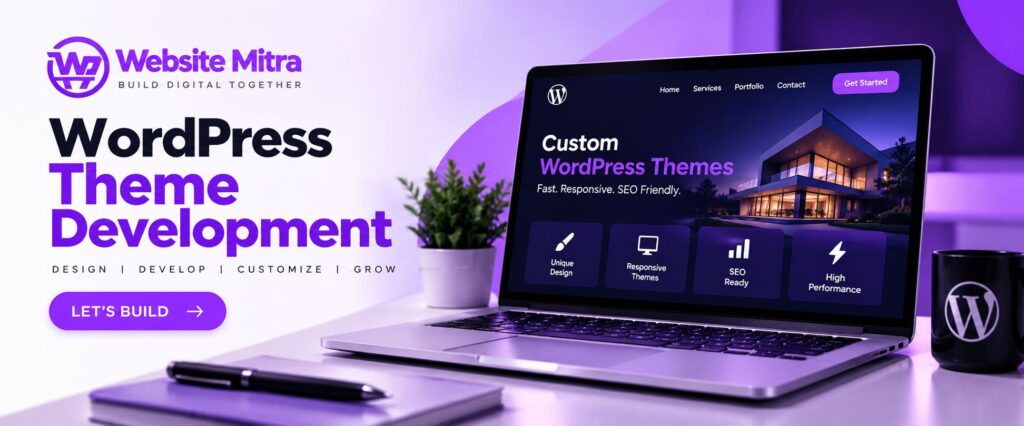
WebsiteMitra presents itself as a WordPress-focused development company offering custom theme development alongside WordPress websites, plugins, WooCommerce, SEO, AI automation and related services. Its published technical information lists technologies including PHP, WordPress, WooCommerce, JavaScript, React, Gutenberg, REST API, MySQL, Git, Composer, WP-CLI and Elementor.
This guide explains what custom WordPress theme development involves, why businesses choose custom themes, what services a professional development company should provide, how the development process works, SEO and performance considerations, costs, common mistakes, FAQs and how to evaluate a WordPress theme development company in India.
Introduction
A WordPress website can be launched using a ready-made theme in a relatively short time.
For some websites, that is perfectly appropriate.
However, as a business grows, the limitations of a generic theme can become increasingly visible.
You may want:
- A completely unique design
- Better performance
- A cleaner codebase
- Custom page layouts
- Advanced WooCommerce templates
- Custom content structures
- Specific branding
- Better mobile experiences
- SEO-friendly architecture
- Custom Gutenberg blocks
- Flexible Site Editor controls
- Integration with business systems
- Less dependence on unnecessary theme features
At this point, custom WordPress theme development becomes an option worth considering.
Instead of modifying hundreds of settings inside a generic template, developers can create a theme specifically around the requirements of the business.
This approach can give businesses greater control over design and functionality while providing a foundation that can evolve as the website grows.
What Is WordPress Theme Development?
WordPress theme development is the process of creating or customizing the presentation layer of a WordPress website.
A theme can control elements such as:
- Header
- Footer
- Navigation
- Typography
- Colors
- Page layouts
- Blog layouts
- Archive pages
- Single-post templates
- Page templates
- Search results
- 404 pages
- Sidebars
- WooCommerce templates
- Block patterns
- Global styles
WordPress’s official Theme Developer Handbook explains that themes can be built as either block themes or classic themes and provides guidance on theme structure, templates, assets, global settings, testing, security and more.
Theme development is therefore considerably broader than simply designing a homepage.
What Is a Custom WordPress Theme?
A custom WordPress theme is a theme created specifically for a particular website, brand or business requirement.
Instead of starting with a theme containing hundreds of features designed for thousands of potential users, developers can build the architecture around the actual project.
For example, a technology company might need:
Home
Services
Solutions
Industries
Case Studies
Resources
Blog
About
Contact
A real-estate company may need:
Home
Properties
Property Details
Locations
Agents
Resources
About
Contact
A SaaS business could require:
Home
Features
Solutions
Pricing
Integrations
Resources
Documentation
Contact
The theme architecture can be developed around these requirements.
Custom WordPress Theme vs. Off-the-Shelf Theme
One of the first decisions businesses make is whether to use a ready-made theme or develop a custom one.
| Feature | Custom WordPress Theme | Off-the-Shelf Theme |
|---|---|---|
| Design | Created for the business | Pre-designed |
| Branding | Highly customizable | Usually configurable |
| Code | Project-specific | General-purpose |
| Features | Only required features can be developed | Often includes many features |
| Performance | Can be optimized around requirements | Depends on theme architecture |
| Scalability | Designed around future requirements | May require workarounds |
| Maintenance | Controlled development | Depends on theme vendor |
| UX | Designed around target users | Based on template |
| SEO architecture | Can be planned from beginning | Depends on implementation |
| Cost | Usually higher initially | Often lower initially |
Neither approach is universally appropriate.
A small personal website may not need a custom theme.
A growing business with unique functionality may benefit from custom development.
WebsiteMitra’s own published guide on custom versus off-the-shelf WordPress themes highlights flexibility, branding, performance and long-term technical considerations when comparing the two approaches.
Why Hire a WordPress Theme Development Company in India?
A professional WordPress theme development company can combine design, development, SEO and technical architecture.
This can be particularly useful when the website requires more than visual customization.
A professional team may provide:
- UI/UX design
- Theme architecture
- Custom theme development
- Responsive development
- Gutenberg/block development
- WooCommerce integration
- Custom templates
- API integration
- Performance optimization
- SEO implementation
- Security practices
- Testing
- Maintenance
For businesses operating in India or targeting international markets, the development partner should ideally understand both WordPress technology and the business objectives behind the website.
WordPress Theme Development Services India
A complete WordPress theme development service can include several components.
1. Custom WordPress Theme Design
The first stage is usually understanding the visual identity of the business.
This includes:
- Brand colors
- Typography
- Logo usage
- Photography
- Icons
- Spacing
- Buttons
- Cards
- Forms
- Navigation
- Content hierarchy
The objective is to create a consistent design system rather than designing every page independently.
2. Custom WordPress Theme Development
After the design is approved, developers convert the UI into a functional WordPress theme.
Depending on the architecture, this may involve:
- PHP
- HTML
- CSS
- JavaScript
- WordPress APIs
- Block APIs
theme.json- Template files
- Custom blocks
- Block patterns
WordPress’s official documentation covers standard theme components such as style.css, functions.php, templates and theme.json, depending on the theme architecture being used.
3. WordPress Block Theme Development
Block themes represent the modern WordPress approach to theme development.
WordPress explains that block themes are primarily composed of blocks and allow users to edit different parts of the website through the Site Editor.
A custom block theme can provide:
- Custom templates
- Custom template parts
- Global styles
- Typography controls
- Color settings
- Custom patterns
- Reusable blocks
- Editor-friendly layouts
This can be particularly useful for businesses that want their internal team to manage layouts without depending on developers for every small change.
4. Classic WordPress Theme Development
Classic themes use the traditional WordPress theme architecture.
They commonly rely on:
- PHP templates
- CSS
- JavaScript
- WordPress template hierarchy
- Hooks
- Filters
- Theme functions
Classic themes remain useful for projects that require specific legacy integrations, established development architectures or particular customization requirements.
WordPress continues to document both classic and block theme development.
5. WordPress Theme Customization
Businesses do not always need a completely new theme.
Sometimes an existing theme can be customized.
Common customization work includes:
- Header redesign
- Footer redesign
- Typography
- Colors
- Navigation
- Blog layouts
- Landing pages
- WooCommerce templates
- Custom sections
- Responsive improvements
- Performance improvements
A development company should first determine whether customization is technically and commercially sensible before recommending a complete rebuild.
6. WooCommerce Theme Development
WooCommerce websites often require specialized theme development.
A custom WooCommerce theme can include:
- Product archive layouts
- Product detail pages
- Category templates
- Shopping cart
- Checkout
- Account pages
- Product filters
- Product variations
- Related products
- Upsells
- Cross-sells
Advanced ecommerce projects may require:
- B2B layouts
- Wholesale pricing displays
- Subscription interfaces
- Product configurators
- Multivendor functionality
- Custom checkout
- API integrations
WebsiteMitra currently lists WooCommerce development and WooCommerce plugin development among its WordPress capabilities.
7. Custom Gutenberg Block Development
Gutenberg provides WordPress’s block-based editing experience.
A custom theme can include custom blocks for frequently used sections.
For example:
- Hero block
- Services block
- Team block
- Testimonial block
- Pricing block
- FAQ block
- Portfolio block
- Case-study block
- CTA block
- Logo grid
- Feature comparison
This can make content management easier for marketing teams.
WordPress also documents block patterns as reusable groups of blocks that can be incorporated into themes.
8. Custom WordPress Theme Patterns
Patterns can allow website administrators to insert predefined layouts into pages.
For example, a business theme could provide:
Hero Pattern
↓
Feature Pattern
↓
Service Pattern
↓
Testimonial Pattern
↓
CTA Pattern
Instead of recreating these sections manually, editors can reuse predefined patterns.
This can improve consistency while making content management more efficient.
9. Elementor-Compatible Theme Development
Some businesses use Elementor as their page-building environment.
A theme can be designed to work appropriately with Elementor while maintaining a clean overall architecture.
Possible requirements include:
- Elementor templates
- Custom widgets
- Theme styling
- Header/footer integration
- Responsive controls
- WooCommerce compatibility
The development approach should be chosen based on how much control the client needs over editing versus custom code.
10. Custom Post Type and Content Architecture
Some businesses require content types beyond standard pages and posts.
For example:
Services
Case Studies
Team
Testimonials
Projects
Locations
Properties
Courses
Events
Products
A custom theme can be designed around these content structures.
WebsiteMitra also offers a Custom Post Type Manager product designed around custom post types, taxonomies and custom fields for content such as services, portfolios, testimonials, products and FAQs.
This can help create a website architecture that is easier to manage and scale.
11. Responsive WordPress Theme Development
A modern theme should work across:
- Desktop
- Laptop
- Tablet
- Smartphone
Responsive design should consider:
- Navigation
- Font sizes
- Buttons
- Images
- Grids
- Tables
- Forms
- Menus
- Popups
- Interactive elements
Google uses the mobile version of a website’s content for indexing and recommends mobile-friendly implementations.
Therefore, mobile design should be considered during theme development rather than after desktop development is complete.
12. SEO-Friendly WordPress Theme Development
An SEO-friendly theme does not guarantee rankings.
However, the theme can either support or create technical obstacles for SEO.
Important considerations include:
- Semantic HTML
- Proper heading hierarchy
- Crawlable navigation
- Clean URLs
- Internal linking
- Image handling
- Performance
- Mobile compatibility
- Structured data compatibility
- Accessibility
- Indexable content
Google’s developer SEO guidance recommends semantic HTML, accessible text content, mobile compatibility, security and fast performance as important foundations for search-friendly websites.
WordPress Theme and Technical SEO
A theme can influence several technical SEO elements.
Semantic HTML
Important content should use appropriate HTML elements.
Examples include:
<header>
<nav>
<main>
<section>
<article>
<footer>
Semantic markup helps establish meaningful document structure.
Heading Hierarchy
A page should have a logical hierarchy:
H1
 ├── H2
 │    ├── H3
 │    └── H3
 └── H2
      └── H3
The exact heading structure depends on the page content.
Crawlable Navigation
Important pages should be accessible through normal links.
Google’s SEO documentation emphasizes crawlable links and making important page information accessible to search engines.
WordPress Theme Performance Optimization
Performance should be considered during theme architecture.
A theme can be optimized through:
- Lightweight CSS
- Efficient JavaScript
- Conditional asset loading
- Optimized images
- Proper font loading
- Reduced third-party scripts
- Efficient templates
- Clean queries
- Caching compatibility
A custom theme can avoid implementing functionality that the business does not need.
WebsiteMitra’s WordPress performance service describes optimization techniques including image optimization, CSS/JS optimization, database optimization, caching, CDN configuration and plugin auditing.
Core Web Vitals and WordPress Themes
Google’s Core Web Vitals focus on loading, responsiveness and visual stability.
The current metrics are:
LCP
Largest Contentful Paint measures loading performance.
INP
Interaction to Next Paint measures responsiveness.
CLS
Cumulative Layout Shift measures visual stability.
Theme architecture can influence these metrics through:
- CSS
- JavaScript
- Images
- Fonts
- Layout structure
- Third-party scripts
However, the theme is only one part of performance. Hosting, plugins, databases, images and external services can also affect real-world results.
WordPress Theme Security
Theme development should follow security best practices.
Important areas include:
- Input sanitization
- Output escaping
- Nonce verification
- Capability checks
- Secure database queries
- Safe API handling
- Proper permissions
- Secure asset loading
WebsiteMitra describes a security-first approach for custom WordPress development, including nonce verification, capability checks, prepared SQL statements, input sanitization and output escaping.
Accessibility in WordPress Theme Development
Accessibility should be considered during development.
A theme should aim to provide usable interfaces for people with different abilities.
Important considerations include:
- Keyboard navigation
- Appropriate color contrast
- Focus states
- Semantic HTML
- Form labels
- Alternative text
- Accessible buttons
- Meaningful link text
- Screen-reader compatibility
The WordPress Theme Handbook includes accessibility among its theme-development topics.
WordPress Theme Development for Different Businesses
Corporate Websites
A corporate website may require:
- Professional homepage
- Service pages
- Industry pages
- Leadership
- Case studies
- Resources
- Careers
- Contact
Startup Websites
Startups often need:
- Strong visual branding
- Landing pages
- Product pages
- Pricing
- Integrations
- Lead generation
- Content marketing
Ecommerce Websites
Ecommerce websites can require:
- WooCommerce
- Product templates
- Category pages
- Checkout
- Payment gateways
- Shipping
- Product filters
Agencies
Agencies may need:
- Portfolio
- Case studies
- Services
- Team
- Testimonials
- Lead forms
- Landing pages
SaaS Businesses
SaaS websites may require:
- Feature pages
- Pricing
- Integrations
- Documentation
- Product screenshots
- Customer stories
- Demo forms
Custom WordPress Theme Development Process
A professional project can follow a structured development process.
Step 1: Requirement Discovery
The development team identifies:
- Business objectives
- Target audience
- Pages
- Features
- Integrations
- Content types
- SEO requirements
- Performance requirements
Step 2: Sitemap
The website structure is planned.
For example:
Home
├── About
├── Services
│   ├── Service A
│   ├── Service B
│   └── Service C
├── Portfolio
├── Resources
│   ├── Blog
│   └── Guides
└── Contact
Step 3: UI/UX Design
Designers create:
- Wireframes
- Visual designs
- Components
- Responsive layouts
- Interactive states
Step 4: Theme Architecture
Developers decide:
- Block or classic theme
- Template structure
- Content architecture
- Custom blocks
- Patterns
- Assets
- Integration approach
Step 5: Development
The theme is then coded and integrated with WordPress.
Step 6: Content Integration
The team implements:
- Pages
- Posts
- Custom post types
- Images
- Menus
- Forms
- Dynamic content
Step 7: Testing
Testing should cover:
- Desktop
- Mobile
- Tablets
- Browsers
- Forms
- Navigation
- Accessibility
- Performance
- Security
- Ecommerce
WordPress recommends developing themes in a separate development environment rather than directly modifying a live production website.
Step 8: SEO Testing
The team checks:
- Indexability
- Metadata
- Heading hierarchy
- Internal links
- Schema
- Sitemap
- Canonicals
- Page speed
WebsiteMitra’s own technical SEO guide identifies crawlability, indexability, Core Web Vitals, mobile usability, security, structured data and site architecture as important WordPress technical SEO areas.
Step 9: Launch
Before launch:
- Backup production website
- Test forms
- Test redirects
- Verify analytics
- Check robots.txt
- Check sitemap
- Test mobile
- Verify important pages
Step 10: Maintenance
After launch, ongoing maintenance may include:
- WordPress updates
- Theme updates
- Security monitoring
- Bug fixes
- Compatibility testing
- Performance monitoring
- New features
How Much Does Custom WordPress Theme Development Cost in India?
There is no single price for WordPress theme development.
The cost depends on the scope.
| Project | Complexity |
|---|---|
| Basic theme customization | Low |
| Small custom business theme | Medium |
| Full custom WordPress theme | Medium–High |
| WooCommerce custom theme | High |
| Enterprise theme | High |
| Custom block theme | Medium–High |
| Complex integrated platform | Very High |
Cost can depend on:
- Number of templates
- Number of pages
- UI/UX complexity
- Custom blocks
- WooCommerce requirements
- API integrations
- Custom post types
- Animation
- Performance requirements
- Accessibility requirements
- SEO requirements
- Testing
- Maintenance
A professional quotation should therefore be based on a written scope rather than only the number of pages.
Custom Theme vs Theme Customization: Which Approach Should You Use?
Consider theme customization when:
- The existing theme is structurally suitable.
- You only need visual changes.
- The website has relatively standard requirements.
- The theme is actively maintained.
- You don’t need extensive custom functionality.
Consider custom theme development when:
- The design is highly unique.
- The website needs specialized templates.
- Performance is important.
- You need custom blocks.
- The business has unusual content structures.
- You need deep WooCommerce customization.
- You want greater control over future development.
A technical evaluation before development can prevent unnecessary costs.
How to Choose a WordPress Theme Development Company India
1. Check the Portfolio
Look for examples showing:
- Different industries
- Responsive layouts
- Custom designs
- Ecommerce
- Complex functionality
2. Check WordPress Expertise
Ask about:
- WordPress core
- Theme development
- Block themes
- Gutenberg
- PHP
- JavaScript
- WooCommerce
- REST APIs
3. Ask About Performance
Find out whether the company considers:
- Core Web Vitals
- Image optimization
- CSS/JS loading
- Caching
- Database performance
4. Ask About SEO
The development team should understand:
- Semantic HTML
- Site architecture
- Crawlability
- Metadata
- Schema
- Internal links
- Mobile SEO
5. Ask About Security
Ask about:
- Sanitization
- Escaping
- Nonces
- Permissions
- Secure queries
- Updates
6. Understand Ownership
Clarify who owns:
- Theme source code
- Design files
- Website
- Domain
- Hosting
- Custom plugins
Why Choose WebsiteMitra for WordPress Theme Development?
WebsiteMitra presents itself as a WordPress-focused development company and lists custom theme development among its related WordPress services. Its published plugin-development page also identifies a technical stack including PHP, WordPress, WooCommerce, JavaScript, React, Gutenberg, REST API, MySQL, Git, Composer, WP-CLI and Elementor.
WebsiteMitra states that it has 12+ years of WordPress expertise, 500+ plugins delivered and 100+ business clients, with services offered across India and international markets. These figures are claims published by WebsiteMitra and should be evaluated alongside its portfolio, references, scope and your own due diligence.
Its published development methodology includes:
- Discovery and planning
- Design and prototyping
- Development and testing
- Deployment and support
The company also describes security-focused development, WordPress coding standards, Git/Composer workflows, PHPUnit testing and ongoing maintenance for its custom development work.
For a business requiring both custom theme development and advanced WordPress functionality, having design and technical development capabilities within the same project can simplify the overall architecture.
Common WordPress Theme Development Mistakes
1. Starting Development Without a Sitemap
A theme should be based on a clear website structure.
2. Building Only for Desktop
Google uses the mobile version of website content for indexing, making mobile compatibility particularly important.
3. Adding Unnecessary Features
A theme does not need every possible feature.
Unnecessary functionality can increase maintenance requirements and complexity.
4. Ignoring Accessibility
A beautiful website should also be usable.
5. Ignoring Performance
A visually impressive theme can still perform poorly if it loads excessive CSS, JavaScript, images or external resources.
6. Hard-Coding Everything
Some parts of the website should remain editable by content managers where appropriate.
7. Mixing Theme and Plugin Responsibilities
Business functionality that should remain available when the visual theme changes may belong in plugins rather than the theme.
This separation can make future redesigns easier.
8. Developing Directly on the Live Website
WordPress recommends using a separate development environment for theme development and testing.
WordPress Theme SEO Checklist
Before launching a custom theme, review:
Technical SEO
- Responsive design
- HTTPS
- Crawlable navigation
- Clean URLs
- XML sitemap
- Canonical URLs
- Robots.txt
- 404 page
- Redirects
- Mobile compatibility
On-Page SEO
- Logical H1/H2/H3 structure
- SEO-friendly title tags
- Meta descriptions
- Internal links
- Descriptive anchor text
- Image alt text
- Optimized images
Performance
- Efficient CSS
- Efficient JavaScript
- Lazy loading where appropriate
- Image optimization
- Font optimization
- Caching compatibility
- Minimal unnecessary scripts
Structured Data
- Organization
- BreadcrumbList
- Article where appropriate
- Product schema for actual product pages
- Other applicable schema
Google explains that structured data can help it understand page content and potentially make pages eligible for supported rich-result features, but correct markup does not guarantee a rich result.
Frequently Asked Questions
1. What is a WordPress theme development company?
A WordPress theme development company designs and develops WordPress themes for businesses. Services may include custom theme development, theme customization, block themes, WooCommerce themes, responsive design, performance optimization and maintenance.
2. What is custom WordPress theme development?
Custom WordPress theme development involves creating a theme specifically for a business rather than relying entirely on a pre-designed template.
3. How much does WordPress theme development cost in India?
The cost depends on the number of templates, design complexity, custom functionality, WooCommerce requirements, integrations, custom blocks, performance requirements and testing.
4. How long does custom WordPress theme development take?
The timeline depends on the scope. A small custom theme may take considerably less time than a complex theme with WooCommerce, custom blocks, APIs and specialized templates.
5. What is the difference between a custom theme and a premium theme?
A premium theme is generally created for many websites and provides configurable features. A custom theme is developed specifically around the requirements of an individual business.
6. Are custom WordPress themes better for SEO?
A custom theme can provide greater control over technical architecture, semantic HTML, performance and page structure. However, a custom theme by itself does not guarantee better rankings. SEO also depends on content, links, technical implementation and many other factors.
7. Can a custom WordPress theme be optimized for Core Web Vitals?
Yes. Theme code, CSS, JavaScript, image handling and layout structure can be optimized for performance. However, hosting, plugins, third-party scripts and content also influence real-world performance.
8. Can you build a custom WooCommerce theme?
Yes. A custom theme can be developed around WooCommerce product, category, cart, checkout and account interfaces, with additional customization depending on requirements.
9. Can custom Gutenberg blocks be included in a WordPress theme?
Yes. Developers can create custom blocks and reusable block patterns as part of a modern WordPress development workflow. WordPress provides official documentation for block themes and patterns.
10. Can an existing WordPress theme be customized?
Yes. Existing themes can often be customized depending on their architecture, licensing, code quality and compatibility with the required changes.
11. Is a custom WordPress theme mobile-friendly?
It can be designed specifically for responsive behavior across desktop, tablet and mobile devices. Mobile design should be tested as part of the development process.
12. Can WordPress themes integrate with Elementor?
Yes. A theme can be designed to work with Elementor where Elementor is part of the website’s content-management workflow.
13. Can WordPress themes support custom post types?
Yes. Custom post types can be used for content such as services, projects, team members, properties, events and other specialized content.
14. Can a WordPress theme integrate with APIs?
Yes. WordPress can communicate with external systems using APIs. The exact implementation depends on the API and business requirements.
15. Should business functionality be inside a WordPress theme?
Not always. Presentation-related functionality generally belongs in the theme, while functionality that should remain available if the theme changes may be better implemented through a plugin.
16. Does WebsiteMitra provide WordPress theme development?
WebsiteMitra’s published WordPress services identify custom theme development among its related services, alongside WooCommerce development, plugin development, SEO, performance optimization, AI automation and other WordPress solutions.
17. Does WebsiteMitra provide custom WordPress plugin development?
Yes. WebsiteMitra publishes a dedicated custom WordPress plugin development service covering WooCommerce plugins, APIs, payment gateways, CRM, ERP, marketplace functionality, AI/ML and automation.
18. How do I choose the right WordPress theme development company in India?
Review the company’s WordPress expertise, portfolio, technical capabilities, development process, SEO knowledge, security practices, performance approach, ownership terms, communication and ongoing support.
Conclusion
A WordPress theme development company India can help businesses build websites around their actual brand, users and technical requirements instead of forcing the business into a generic template.
Custom theme development can provide control over:
- Design
- User experience
- Responsive layouts
- Content architecture
- Gutenberg blocks
- WordPress templates
- WooCommerce
- SEO foundations
- Performance
- Accessibility
- Security
- Future scalability
The decision between a custom theme and an existing theme should ultimately depend on the project’s requirements.
For a simple website, a well-maintained existing theme may be sufficient.
For a business requiring unique branding, custom templates, advanced ecommerce, custom blocks, integrations or a highly controlled technical architecture, custom WordPress theme development can be a more suitable approach.
WordPress itself provides extensive documentation for modern block themes, classic themes, templates, theme.json, patterns, accessibility, security, testing and theme development workflows.
WebsiteMitra positions its WordPress services around custom development, themes, plugins, WooCommerce, SEO, performance, AI automation and related technical services. Its published technical information also describes a development process based on discovery, design, development, testing and ongoing support.
Ultimately, the best WordPress theme is not necessarily the one with the most features. It is the one whose design, code, content architecture and functionality fit the business requirements while remaining maintainable as the website grows.