Summary
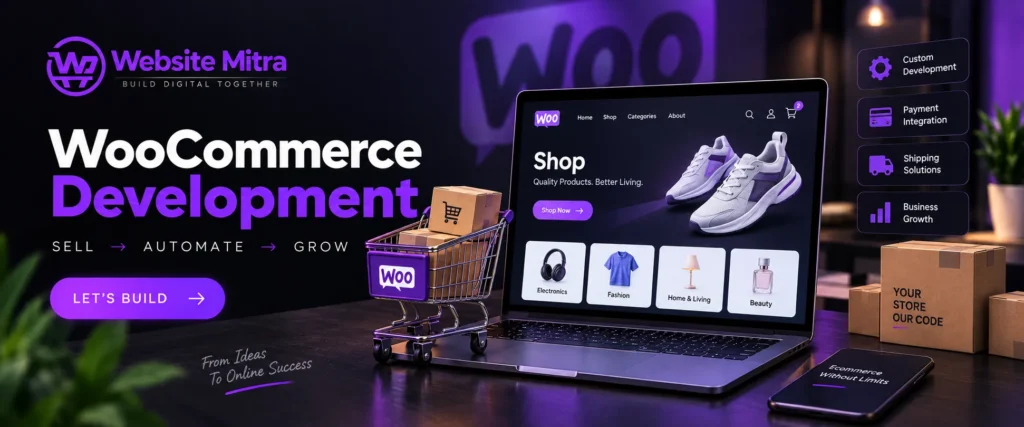
WooCommerce has become a flexible option for businesses that want to build and manage an online store using WordPress. It can support physical products, digital products, subscriptions, different payment methods, shipping rules, product variations, customer accounts and many other ecommerce workflows. WooCommerce describes itself as a customizable, open-source ecommerce platform built on WordPress, with support for products ranging from physical goods and downloads to subscriptions and appointments.
However, installing WooCommerce is only the beginning. A successful ecommerce store needs thoughtful UI/UX, fast performance, secure checkout, appropriate payment and shipping integrations, search-engine-friendly architecture, product data, analytics and ongoing maintenance.
This is where WooCommerce development services India can help businesses turn a basic WordPress installation into a customized ecommerce platform.
WebsiteMitra works with WordPress and WooCommerce technologies and lists WooCommerce plugin development, payment gateway integrations, marketplace and multivendor functionality, REST API integrations, automation and other custom development capabilities among its services. Its published technology stack includes PHP, WordPress, WooCommerce, JavaScript, React, REST API, MySQL, Git, Composer and WP-CLI.
Introduction
Ecommerce customers expect more than an attractive website.
They expect products to load quickly, categories to be easy to navigate, product information to be clear, checkout to be simple, payments to work smoothly and the entire shopping experience to function properly on mobile devices.
For businesses in India, an ecommerce store may also need to accommodate local payment methods, GST-related workflows, Cash on Delivery, regional shipping requirements, multilingual content, multiple currencies, marketplace integrations, CRM systems and business-specific automation.
A standard WooCommerce installation can provide a strong foundation, but many businesses eventually require customization.
For example:
- A fashion brand may need product size and color variations.
- A B2B company may need wholesale pricing.
- A furniture business may need product customization.
- A subscription business may need recurring billing.
- A marketplace may need multiple vendors.
- A manufacturer may need ERP synchronization.
- A retailer may need inventory synchronization between physical and online stores.
- A growing ecommerce company may need custom APIs and automation.
This makes professional WooCommerce development services in India particularly useful for businesses that need an ecommerce platform designed around their actual business processes rather than simply using a collection of generic plugins.
What Are WooCommerce Development Services?
WooCommerce development services involve designing, developing, customizing, integrating, optimizing and maintaining ecommerce websites powered by WooCommerce and WordPress.
These services can range from simple store setup to complex enterprise ecommerce development.
A WooCommerce development agency may provide:
- WooCommerce store development
- Custom WooCommerce website development
- WooCommerce theme development
- WooCommerce theme customization
- Custom plugin development
- Payment gateway integration
- Shipping integration
- CRM integration
- ERP integration
- Inventory integration
- API development
- Third-party API integration
- Subscription functionality
- Membership functionality
- Multivendor marketplace development
- Product customization
- B2B ecommerce functionality
- Performance optimization
- WooCommerce SEO
- Security optimization
- Migration
- Maintenance and support
WooCommerce’s own developer documentation includes resources for building and extending WooCommerce themes and extensions, demonstrating how the platform is designed to be customized beyond its basic installation.
Why Choose WooCommerce for Ecommerce Development?
1. WooCommerce Is Flexible
One of the biggest advantages of WooCommerce is flexibility.
Businesses can start with a relatively simple store and gradually add functionality as their requirements become more sophisticated.
Instead of rebuilding an ecommerce platform whenever the business changes, developers can extend the existing WordPress and WooCommerce architecture.
2. It Supports Different Business Models
WooCommerce can be used for numerous ecommerce models, including:
- B2C stores
- B2B stores
- D2C brands
- Subscription businesses
- Digital products
- Physical products
- Membership businesses
- Wholesale stores
- Multivendor marketplaces
- Service-based businesses
- Product customization businesses
The appropriate architecture depends on the business model and technical requirements.
3. Customization Possibilities
WooCommerce can be customized through themes, plugins, hooks, APIs and custom development.
This makes it possible to create functionality specifically around a company’s workflow.
For example, a business could implement:
Customer → Product Configuration → Custom Pricing → Payment → ERP → Fulfillment
rather than forcing its operations into a standard store workflow.
WooCommerce Development Services India: What Does a Professional Development Company Provide?
A comprehensive WooCommerce development service can cover the entire ecommerce lifecycle.
1. Custom WooCommerce Website Development
Custom WooCommerce website development involves creating an ecommerce store around the company’s branding, products, customers and operational requirements.
A custom store can include:
- Custom homepage
- Product category pages
- Product pages
- Custom navigation
- Shopping cart
- Checkout
- Customer account area
- Wishlist
- Product filters
- Search
- Reviews
- Coupons
- Related products
- Upsells and cross-sells
- Custom landing pages
The objective is not simply to make a store look different.
The architecture should support usability, performance, SEO and future growth.
2. WooCommerce Theme Development
The theme determines much of the visual presentation of a WooCommerce store.
Professional WooCommerce theme development can include:
- Custom layouts
- Responsive design
- Product page templates
- Category templates
- Checkout design
- Cart customization
- Account dashboard design
- Header and footer customization
- Mobile navigation
- Typography
- Brand styling
- Conversion-focused components
A custom theme can be useful when an existing theme does not provide the design flexibility or performance characteristics required by the business.
3. WooCommerce Theme Customization
Not every business needs a completely new theme.
Sometimes an existing theme can be customized.
Customization may involve:
- Changing layouts
- Modifying product pages
- Adding custom sections
- Changing checkout fields
- Improving mobile layouts
- Adding promotional components
- Customizing product filters
- Modifying WooCommerce templates
This can be appropriate when the existing theme already provides a suitable foundation.
4. Custom WooCommerce Plugin Development
Plugins allow developers to add specialized functionality without changing WooCommerce’s core files.
Custom plugins can be created for:
- Product customization
- Bulk pricing
- Wholesale pricing
- Custom checkout fields
- Shipping calculations
- Payment gateways
- CRM synchronization
- ERP synchronization
- Product imports
- Inventory management
- Customer-specific pricing
- Order automation
- Membership functionality
- Vendor management
- Reporting
WebsiteMitra specifically lists WooCommerce plugin development, payment gateway integration, CRM and ERP integrations, marketplace and multivendor plugins, REST APIs and automation plugins among its development capabilities.
5. WooCommerce Payment Gateway Integration
Payment functionality is one of the most important components of an ecommerce website.
Depending on the business and target customers, developers may integrate appropriate payment solutions for:
- Credit cards
- Debit cards
- UPI
- Net banking
- Digital wallets
- Cash on Delivery
- International payments
- Bank transfers
- Recurring payments
WooCommerce provides documentation covering payment options including bank transfer, Cash on Delivery and other payment gateway choices.
A professional implementation should also consider:
- Checkout security
- Failed transactions
- Payment callbacks
- Refund workflows
- Order status synchronization
- Webhooks
- Transaction logging
- Duplicate payment protection
6. WooCommerce Shipping Integration
Shipping can become complicated as an ecommerce business grows.
A store may have different shipping rates based on:
- Location
- Product weight
- Product dimensions
- Order value
- Pin code
- Shipping zone
- Delivery speed
- Product category
- Free-shipping threshold
Custom WooCommerce development can connect the store to shipping providers and automate order fulfillment workflows.
WooCommerce documentation also provides dedicated resources for shipping zones and order fulfillment.
7. WooCommerce CRM Integration
Connecting WooCommerce with a CRM can help businesses centralize customer information.
Possible workflows include:
New Customer → WooCommerce → CRM
New Order → WooCommerce → CRM
Customer Update → WooCommerce → CRM
Depending on the CRM, integration can synchronize:
- Customer name
- Phone
- Orders
- Purchase history
- Customer status
- Lead information
- Marketing information
This can reduce repetitive manual data entry.
8. WooCommerce ERP Integration
Growing ecommerce companies may use ERP systems for inventory, accounting, procurement, production and fulfillment.
WooCommerce can be connected with ERP systems through APIs or custom middleware.
Possible synchronization includes:
- Products
- SKUs
- Inventory
- Orders
- Customers
- Prices
- Tax information
- Shipping information
- Returns
The exact integration architecture depends on the ERP and business workflow.
9. WooCommerce API Integration
API integrations allow WooCommerce to communicate with external applications.
Examples include:
- CRM
- ERP
- Accounting software
- Shipping platforms
- Payment systems
- Mobile applications
- Marketing platforms
- AI services
- Inventory platforms
- Business dashboards
A properly designed API integration can make WooCommerce part of a larger digital ecosystem instead of functioning as an isolated website.
10. WooCommerce Multivendor Marketplace Development
A normal WooCommerce store generally has one primary seller.
A marketplace can introduce multiple vendors.
A custom marketplace may need:
- Vendor registration
- Vendor dashboards
- Product submission
- Product approval
- Vendor commissions
- Vendor payouts
- Vendor-specific orders
- Vendor reports
- Vendor shipping
- Vendor permissions
WebsiteMitra’s published plugin-development page describes multivendor marketplace development as one of its WooCommerce-related capabilities.
11. WooCommerce B2B Development
B2B ecommerce often requires functionality that differs from normal consumer shopping.
Possible features include:
- Wholesale pricing
- Customer-specific pricing
- Minimum order quantities
- Bulk ordering
- Quote requests
- Business accounts
- Multiple users per company
- Purchase approval
- Tax information
- Tiered pricing
- Hidden prices
- Custom payment terms
A custom WooCommerce solution can implement these requirements around the company’s sales process.
12. Product Customization Development
Businesses selling customizable products may require customers to configure products before purchasing.
Examples include:
- Customized T-shirts
- Printed products
- Furniture
- Jewelry
- Gifts
- Packaging
- Promotional products
A product customization system might allow customers to:
- Select a product.
- Choose options.
- Upload artwork.
- Add text.
- Preview the design.
- Calculate the final price.
- Add the customized product to the cart.
The underlying implementation can use custom WooCommerce logic, JavaScript, APIs and database structures depending on complexity.
13. WooCommerce Subscription Development
Subscription ecommerce can be used for:
- Monthly products
- Memberships
- Software
- Digital content
- Subscription boxes
- Recurring services
A subscription system may require:
- Recurring billing
- Subscription management
- Renewal notifications
- Failed-payment handling
- Cancellation
- Upgrade/downgrade functionality
- Customer account management
The architecture should be planned carefully because recurring orders introduce additional business logic.
14. WooCommerce Performance Optimization
A beautiful ecommerce website is not enough if it performs poorly.
Large ecommerce stores can contain:
- Thousands of products
- Multiple product variations
- Large images
- Numerous plugins
- Complex queries
- External API requests
- Tracking scripts
Performance optimization may involve:
- Image optimization
- Caching
- Database optimization
- Query optimization
- CDN configuration
- Lazy loading
- CSS optimization
- JavaScript optimization
- Object caching
- Conditional asset loading
- Reducing unnecessary plugins
- Improving server response time
WebsiteMitra’s technical SEO guidance identifies Core Web Vitals, caching, image optimization, server response time, JavaScript and CSS optimization among areas that can require attention in WordPress websites.
15. WooCommerce Security
An ecommerce website handles sensitive business and customer information, so security should be considered throughout development.
Important areas include:
- HTTPS
- Secure authentication
- User permissions
- Input sanitization
- Output escaping
- Nonce verification
- Prepared database queries
- Secure API authentication
- Regular updates
- Backups
- Malware monitoring
- Plugin security
WebsiteMitra states that its custom plugin development process includes nonce verification, capability checks, prepared SQL statements, output escaping and input sanitization.
16. WooCommerce SEO Services
WooCommerce SEO is more than adding keywords to product descriptions.
An ecommerce SEO strategy should consider:
- Product titles
- Product descriptions
- Category pages
- Product URLs
- Internal linking
- Breadcrumbs
- Product structured data
- Image optimization
- Canonical URLs
- XML sitemaps
- Mobile performance
- Site architecture
- Search filters
- Duplicate URLs
- Pagination
- Reviews
- Content marketing
Google recommends paying attention to ecommerce site structure, product data and structured data because these help Google understand ecommerce websites and their products.
WooCommerce Site Architecture for SEO
A logical structure could look like:
Homepage
│
├── Shop
│   ├── Category
│   │   ├── Subcategory
│   │   │   ├── Product
│   │   │   └── Product
│   │   └── Product
│   └── Category
│
├── About
├── Blog
└── Contact
Google explains that it uses relationships between pages and links to understand ecommerce site structure. It recommends linking from categories to subcategories and products and ensuring important products can be discovered through crawlable links.
Therefore, ecommerce navigation should be designed for both humans and search engines.
Product Schema for WooCommerce
Product structured data can help search engines understand information such as:
- Product name
- Price
- Availability
- Reviews
- Ratings
- Shipping information
- Product variants
Google states that Product structured data can make product pages eligible for richer search appearances, although structured data does not guarantee that a rich result will appear.
For stores selling products directly online, merchant-listing structured data may also be relevant. Google distinguishes between product snippets and merchant listings depending on the page and purchasing experience.
WooCommerce Migration Services
Businesses sometimes migrate from:
- Shopify
- Magento
- OpenCart
- Wix
- Custom ecommerce platforms
- Older WooCommerce websites
A WooCommerce migration should not be treated as simply moving product data.
A proper migration can include:
Content Migration
- Products
- Categories
- Customers
- Orders
- Pages
- Blog posts
SEO Migration
- Existing URLs
- Redirects
- Metadata
- Canonicals
- Sitemap
- Internal links
Technical Migration
- Database
- Images
- Plugins
- Theme
- Payment gateways
- Shipping systems
- APIs
WooCommerce itself provides migration documentation for moving from platforms such as Shopify and Wix.
WooCommerce Mobile Optimization
A significant portion of ecommerce activity can happen through mobile devices.
Therefore, a WooCommerce store should provide:
- Responsive layouts
- Mobile-friendly navigation
- Easy product filtering
- Fast image loading
- Mobile-friendly checkout
- Large tap targets
- Easy-to-use forms
- Optimized payment experience
A responsive design should not simply shrink the desktop layout.
The mobile shopping journey should be intentionally designed.
WooCommerce Conversion Rate Optimization
SEO brings visitors.
UX and conversion optimization help turn those visitors into customers.
Useful ecommerce conversion elements include:
- Clear product photography
- Strong product descriptions
- Visible pricing
- Clear Add to Cart buttons
- Reviews
- Shipping information
- Return information
- Trust signals
- Product availability
- Related products
- Upsells
- Cross-sells
- Simple checkout
The goal should be to remove unnecessary friction from the customer journey.
WooCommerce AI and Automation
AI can also be incorporated into WooCommerce websites.
Potential applications include:
- AI product recommendations
- AI customer support
- Product Q&A
- Automated support responses
- Product description assistance
- Order-status assistants
- Internal search
- Customer segmentation
- Marketing automation
WebsiteMitra has also published guidance on integrating AI into WordPress through plugins, APIs, custom development, RAG systems and AI agents, including ecommerce-related applications such as product recommendations, product Q&A and order support.
AI should be implemented around a genuine business use case rather than added simply because it is technically possible.
WooCommerce Development Process
A professional WooCommerce project can follow a structured development process.
Step 1: Discovery
The development team understands:
- Business model
- Products
- Customers
- Competitors
- Required features
- Integrations
- Marketing goals
- Technical constraints
Step 2: Requirement Planning
Requirements are organized into:
- Core features
- Optional features
- Integrations
- Design requirements
- Security requirements
- SEO requirements
- Performance requirements
Step 3: UX/UI Design
Designers create:
- Wireframes
- Homepage
- Category pages
- Product pages
- Cart
- Checkout
- Customer account
- Mobile layouts
Step 4: Development
Developers implement:
- WooCommerce
- Theme
- Plugins
- Custom functionality
- APIs
- Payment gateways
- Shipping
- CRM/ERP integrations
Step 5: Testing
Testing can cover:
- Product functionality
- Cart
- Checkout
- Payments
- Coupons
- Shipping
- Mobile responsiveness
- Browser compatibility
- Security
- Performance
- APIs
- Order workflows
Step 6: SEO Implementation
The team checks:
- Metadata
- URLs
- Internal links
- Breadcrumbs
- Schema
- Sitemap
- Canonicals
- Indexability
- Product content
Step 7: Launch
Before launch:
- Backup the website
- Test critical workflows
- Configure analytics
- Check Search Console
- Verify redirects
- Test payment systems
- Test forms
- Check mobile experience
Step 8: Maintenance
After launch:
- Update WordPress
- Update WooCommerce
- Update plugins
- Monitor security
- Monitor performance
- Fix bugs
- Test integrations
- Review analytics
How Much Do WooCommerce Development Services Cost in India?
There is no single price for WooCommerce development.
The cost depends on the complexity of the project.
| Project Type | Typical Complexity |
|---|---|
| Basic WooCommerce store | Low |
| Customized ecommerce website | Medium |
| Custom WooCommerce store | Medium–High |
| B2B ecommerce platform | High |
| Subscription store | High |
| Multivendor marketplace | High |
| ERP/CRM-integrated ecommerce | High |
| Enterprise WooCommerce platform | Very High |
Factors affecting cost include:
- Number of pages
- Number of products
- Custom design
- Custom plugins
- API integrations
- Payment gateways
- Shipping integrations
- ERP/CRM integrations
- Product customization
- Multivendor functionality
- Subscription functionality
- SEO requirements
- Performance requirements
- Security requirements
- Maintenance requirements
The best way to estimate a project is to define requirements first and then prepare a technical scope.
Why Choose WebsiteMitra for WooCommerce Development?
WebsiteMitra positions itself around WordPress and custom development and publishes WooCommerce-related capabilities including custom WooCommerce plugins, payment gateway integrations, marketplace/multivendor functionality, API integration and automation.
Its published technology stack includes:
- PHP
- WordPress
- WooCommerce
- JavaScript
- React
- Gutenberg
- REST API
- MySQL
- Git
- Composer
- WP-CLI
- Elementor
The company states that it has 12+ years of WordPress experience, 500+ plugins delivered and 100+ business clients, and says it serves businesses in India as well as the USA, UK, Canada and Australia. These are claims published by WebsiteMitra and should be evaluated alongside your own project requirements and due diligence.
WebsiteMitra also describes a development approach involving discovery, design/prototyping, development/testing, deployment and ongoing support.
For businesses that need WooCommerce functionality beyond standard configurations, a development partner with experience in custom WordPress and plugin development can be useful because ecommerce requirements often involve integrations and business logic rather than design alone.
Common WooCommerce Development Mistakes to Avoid
1. Installing Too Many Plugins
More plugins can introduce additional maintenance, compatibility and performance considerations.
Use plugins because they solve a genuine requirement.
2. Ignoring Mobile Users
A store that works well on desktop but poorly on mobile can create unnecessary friction.
3. Building Without SEO Architecture
SEO should be considered before hundreds or thousands of product pages are created.
4. Ignoring Performance
Large images, unnecessary scripts, excessive plugins and inefficient queries can affect performance.
5. Making Checkout Complicated
Every unnecessary field or step can create friction.
6. No Backup Strategy
An ecommerce website should have a reliable backup and recovery process.
7. Modifying Plugin Core Files
Customizations should be implemented in maintainable ways wherever possible rather than creating upgrade problems.
8. Ignoring Future Scalability
A store should be planned around expected growth.
Ask:
- What happens when products increase?
- What happens when traffic increases?
- What happens when orders increase?
- What happens when a CRM is added?
- What happens when an ERP is introduced?
WooCommerce SEO Checklist
Use this checklist when launching a WooCommerce website:
Technical SEO
- HTTPS enabled
- XML sitemap configured
- Robots.txt reviewed
- Canonicals configured
- 404 errors checked
- Redirects configured
- Mobile usability tested
- Core Web Vitals monitored
- Website architecture reviewed
On-Page SEO
- Unique product titles
- Unique descriptions
- Optimized category pages
- SEO-friendly URLs
- Optimized images
- Internal linking
- Breadcrumbs
- Metadata
- Helpful ecommerce content
Ecommerce SEO
- Product schema
- Product variants handled correctly
- Product availability
- Pricing information
- Reviews
- Shipping information
- Return policy information
- Google Merchant Center where appropriate
Google recommends combining product structured data with Merchant Center product feeds where feasible because the two can provide complementary product information and help Google understand and verify ecommerce data.
Internal Linking Strategy for This Article
To strengthen the SEO architecture of a WooCommerce services website, this article can internally link to relevant WebsiteMitra pages such as:
- WordPress Development Services
- Custom WordPress Development
- WordPress Plugin Development
- WordPress SEO Services
- WordPress Speed Optimization
- Website Audit Services
- AI & Automation
- REST API Development
- WordPress Maintenance
- Contact/Quote page
Google notes that internal links help it understand the relationships and relative importance of pages across an ecommerce website.
Use descriptive anchor text rather than repeatedly using generic phrases such as “click here.”
Frequently Asked Questions About WooCommerce Development Services India
1. What are WooCommerce development services?
WooCommerce development services include designing, developing, customizing, integrating, optimizing and maintaining ecommerce websites built with WooCommerce and WordPress.
2. Why should I choose WooCommerce for my online store?
WooCommerce is an open-source ecommerce platform built on WordPress and offers extensive customization possibilities. It can support physical products, digital products, subscriptions and other ecommerce models.
3. How much does WooCommerce development cost in India?
The cost depends on project complexity. A basic store will generally require less development than a custom ecommerce platform involving APIs, ERP, CRM, subscriptions or marketplace functionality. A detailed quotation should be prepared after defining the project requirements.
4. How long does WooCommerce website development take?
The timeline depends on the number of pages, products, integrations, custom features, design requirements and testing requirements. A simple store may require considerably less development time than an enterprise ecommerce platform.
5. Can you build a custom WooCommerce website?
Yes. WooCommerce can be customized through themes, plugins, custom development, APIs and integrations. WebsiteMitra’s published services include custom WooCommerce plugin development and related WordPress development capabilities.
6. Can WooCommerce integrate with an ERP?
Yes. WooCommerce can communicate with ERP systems through APIs or custom integrations. Depending on the ERP, data such as products, inventory, orders, customers and pricing can potentially be synchronized.
7. Can WooCommerce integrate with a CRM?
Yes. WooCommerce can be integrated with CRM platforms to synchronize customer and order information and support automated workflows.
8. Can you develop a WooCommerce marketplace?
Yes. WooCommerce can be extended to support multivendor functionality, including vendor accounts, products, commissions, dashboards and order management. The exact functionality depends on the marketplace requirements.
9. Can WooCommerce support UPI and other Indian payment methods?
WooCommerce supports a range of payment gateway integrations. The specific options available depend on the payment provider, business requirements and geographic availability. WooCommerce provides documentation covering its payment ecosystem and payment configuration.
10. Can WooCommerce support Cash on Delivery?
Yes. Cash on Delivery is supported as a WooCommerce payment option.
11. Is WooCommerce good for SEO?
WooCommerce can support SEO-friendly ecommerce websites, but the implementation matters. Site architecture, internal links, product content, technical SEO, structured data, performance and crawlability all need attention.
12. Can WooCommerce product pages use schema markup?
Yes. Product structured data can be implemented on appropriate product pages. Google says this can make product pages eligible for richer search appearances, although Google does not guarantee that a rich result will appear.
13. Can you migrate my existing ecommerce website to WooCommerce?
Yes, WooCommerce can be used as a destination for ecommerce migrations. A professional migration should consider products, customers, orders, URLs, redirects, SEO, images, payment systems and integrations. WooCommerce provides migration documentation for several ecommerce platforms.
14. Can WooCommerce handle thousands of products?
WooCommerce can be used for large catalogs, but performance and architecture become increasingly important as product, variation, traffic and order volumes grow.
Database optimization, caching, hosting, search, image optimization and efficient plugins can become important considerations.
15. Can WooCommerce support subscriptions?
Yes. WooCommerce can be extended to support subscription-based business models. WooCommerce’s developer documentation describes the platform as supporting products and services including subscriptions.
16. Can WooCommerce be integrated with custom APIs?
Yes. WooCommerce can communicate with external systems through APIs and custom development. WebsiteMitra lists REST API integration among its WordPress and WooCommerce development capabilities.
17. Do WooCommerce websites need maintenance?
Yes. Ecommerce websites should be maintained regularly. Updates, security monitoring, backups, compatibility testing, performance monitoring and troubleshooting can help maintain the website over time.
18. Can WebsiteMitra develop custom WooCommerce plugins?
WebsiteMitra’s published plugin-development service specifically lists WooCommerce plugin development, payment gateway integration, CRM/ERP integrations, multivendor functionality and automation among its capabilities.
Conclusion
WooCommerce development services India can provide businesses with much more than a standard online store.
A professionally developed WooCommerce website can combine:
- Custom design
- Ecommerce functionality
- Payment integration
- Shipping
- Product management
- CRM integration
- ERP integration
- Custom plugins
- APIs
- Automation
- SEO
- Performance optimization
- Security
- Analytics
- Ongoing maintenance
The most important consideration is to build the store around the business rather than simply installing WooCommerce and adding plugins.
For a small business, that may mean a clean, fast and conversion-focused store.
For a growing ecommerce company, it may mean custom integrations, automation and advanced product management.
For a B2B company, it may mean wholesale pricing, customer-specific catalogs and ERP synchronization.
For a marketplace, it may mean vendors, commissions and separate dashboards.
The underlying principle is the same: your WooCommerce website should be designed around your customers, business processes and future growth.
WebsiteMitra publishes WooCommerce and WordPress development capabilities including custom plugins, integrations, APIs, automation and ecommerce-related development.
If your business is planning a new ecommerce store, redesigning an existing store or building custom WooCommerce functionality, defining the requirements and technical architecture before development can make the project considerably easier to manage.