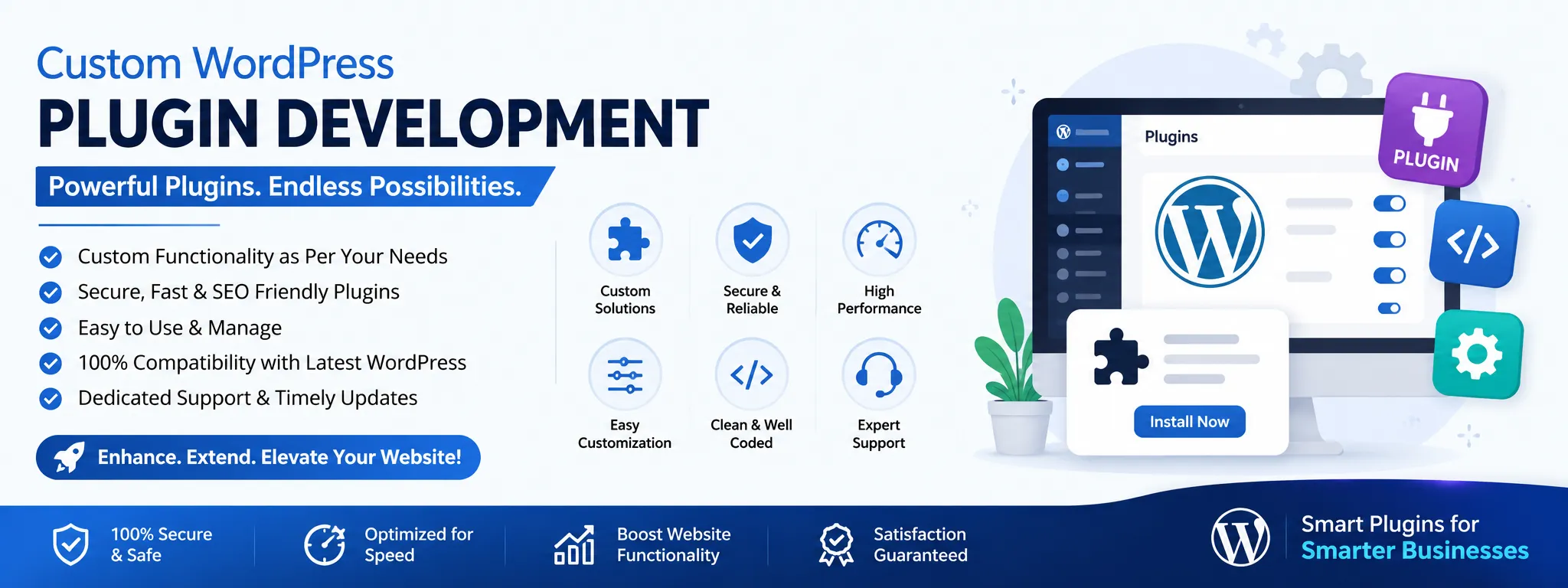

Here is the Yoast metadata you need to copy and paste into your WordPress backend, followed by the fully revised, SEO-optimized script. I have set your focus keyphrase to “Custom WordPress Plugin Development” and integrated it perfectly into your title, slug, meta description, introduction, subheadings, and image alt text to turn all those indicators green.
⚙️ Your Yoast SEO Metadata (Copy & Paste these into Yoast)
Focus Keyphrase: Custom WordPress Plugin Development
SEO Title: Custom WordPress Plugin Development: The Ultimate Guide
Slug: custom-wordpress-plugin-development
Meta Description: Discover why Custom WordPress Plugin Development gives you unlimited flexibility. Learn the steps, costs, and benefits of building bespoke plugins for your site.
Custom WordPress Plugin Development: The Ultimate Guide
???? Key Takeaways
Custom WordPress Plugin Development gives you unlimited flexibility and peak performance.
Bespoke plugins are essential for unique business workflows, especially for eCommerce, membership, and task automation.
Low-cost development is highly achievable with incredibly clear requirements and expert guidance.
Fast turnaround times can be achieved using modern local tools and highly experienced developers.
Always prioritize strict security, scalability, and code quality when building your custom software.
(Insert Featured Image Here) Image Alt Text: A web developer coding and testing Custom WordPress Plugin Development projects.
Introduction
Welcome to the ultimate guide on Custom WordPress Plugin Development. If you’ve ever felt severely limited by off-the-shelf plugins, you’re not alone. Millions of website owners face the exact same frustration: either the commercial plugin does way too much, or it simply does not do enough. That’s exactly where custom engineering changes the game.
Whether you’re a business owner, a technical developer, or a project manager, this comprehensive guide will thoroughly walk you through everything you need to know about building bespoke solutions. We’ll carefully cover how to achieve this at a low cost, strategies for fast delivery, and exactly how to develop a tailored extension that perfectly fits your digital vision.
Throughout this article, we’ll also point you directly to WordPressPluginShop.com, where you can easily find ready-made solutions or safely order bespoke development.
What Is Custom WordPress Plugin Development?
Custom WordPress Plugin Development is the highly specialized process of creating a bespoke software extension tailored specifically to your website’s unique requirements. Unlike premium commercial plugins that attempt to serve a massive, broad audience, a bespoke plugin is built entirely from scratch—or heavily modified from a base framework—to securely handle the exact functionalities your project demands.
This targeted engineering can range from a relatively simple custom payment gateway integration to incredibly complex CRM builds, specialized booking systems, or robust automation tools. Ultimately, when you invest in custom engineering, you fully own the proprietary code, the precise features, and the future development roadmap.
Why It Matters
Why should you seriously consider Custom WordPress Plugin Development over simply using existing retail solutions? The direct answer is simple: unparalleled precision and performance. Off-the-shelf plugins are notoriously bloated, often heavily packed with hundreds of features you’ll never actually use. Consequently, this slows down your site and creates unnecessary security risks.
Unique workflows: Your business processes are entirely unique; your digital tools should be too.
Scalability: A custom-built extension seamlessly grows with your business without ever breaking.
Integration: If you need bespoke WooCommerce services or AI integration, custom engineering is often the only reliable way.
No subscription fees: You own your plugin outright, drastically lowering your overhead costs over the long run.
Benefits of Custom WordPress Plugin Development
Here are the absolute top benefits of choosing a bespoke engineering approach for your platform:
Security: Less code directly translates to fewer vulnerabilities. Bespoke plugins are essentially invisible to automated mass hacker attacks.
Performance: Your server only loads the exact code you need, entirely eliminating frontend and backend bloat.
Perfect Fit: The software is perfectly tailored for niche membership websites, complex eCommerce platforms, or unique service portals.
Full Control: You exclusively decide on the update schedule, feature rollouts, and third-party integrations.
Cost-Effective Long-Term: While the upfront cost of bespoke engineering may seem higher, you permanently avoid recurring annual subscription fees.
API & AI Ready: You can seamlessly integrate with any open third-party API or cutting-edge artificial intelligence model.
⚙️ How It Works
The standard lifecycle of Custom WordPress Plugin Development typically follows a highly proven, structured methodology:
Discovery & Requirements: First, strictly define exactly what your software must do.
Architecture & Planning: Next, securely map out the database schema, API connections, and user flow.
Development: Then, write incredibly clean, secure PHP and JS code following official core standards.
Testing: Following the build, execute rigorous unit tests, integration tests, and quality assurance sweeps.
Deployment & Documentation: Install the finalized tool on the live production site and provide a clear user guide.
Maintenance: Finally, provide ongoing security updates and technical support.
Are you looking for fast deployment? A streamlined discovery phase paired with highly experienced developers can easily turn around a basic build in just 3–5 days.
Step-by-Step Guide: How to Develop a Custom Plugin
Follow this straightforward guide to successfully develop a custom extension from scratch:
Step 1: Set Up Your Local Environment Use LocalWP, XAMPP, or Docker to securely create a fresh, isolated local installation.
Step 2: Create the Plugin Folder & Main File Inside your /wp-content/plugins/ directory, create a new folder named my-custom-plugin. Inside that folder, create a file named my-custom-plugin.php containing the standard header block.
Step 3: Define Core Hooks & Functions Use standard actions and filters. For instance, to efficiently add a custom shortcode, hook into the system using add_shortcode().
Step 4: Add the Admin Menu & Settings Use the add_menu_page() function to cleanly generate your dedicated backend administration interface.
Step 5: Database Integration Use $wpdb->query() or build out custom tables if necessary. Always rigorously sanitize and validate your data inputs.
Step 6: Testing & Debugging Strictly enable WP_DEBUG. Actively test your software with multiple different themes and verify compatibility with core updates.
Step 7: Deploy & Document Zip the final folder, directly upload it via your Plugins dashboard, and provide incredibly clear instructions for your users.
(Need help? Visit WordPressPluginShop.com for professional engineering services).
Real-World Examples
Advanced WooCommerce Customization: A membership site desperately needed a dynamic pricing rule based entirely on user roles. We built a highly lightweight plugin that effectively added two simple filters to achieve this without bloat.
AI Content Integration: We successfully integrated the OpenAI API to automatically generate unique product descriptions upon saving a post draft.
Bespoke Booking Systems: We engineered a dedicated doctor appointment system featuring a customized interactive calendar and direct Stripe payment processing.
Internal CRM Tools: We developed a tailored lead management dashboard directly within the backend for a fast-growing real estate agency.
Comparison Table: Custom vs. Premium Plugin
⚠️ Common Mistakes in Custom Plugin Development
No planning: Jumping directly into the code without writing clear specifications always leads to scope creep.
Hardcoding values: You should always use global constants or dedicated settings pages instead of hardcoding data.
Ignoring security: Failing to sanitize database inputs or effectively escape your outputs is incredibly dangerous.
Not following standard coding guidelines: Writing messy PHP heavily breaks forward compatibility with the core software.
Skipping documentation: Even purely internal plugins strictly require documentation for future maintenance.
???? Expert Tips for Success
Start aggressively with a minimum viable product (MVP) and carefully iterate based on real feedback.
Use Composer for highly efficient dependency management during the build process.
Always utilize
WP_Queryinstead of writing raw SQL commands whenever possible.To achieve fast delivery, safely reuse proven code snippets strictly from trusted developer sources.
Test your final build against beta versions of the core software to guarantee forward compatibility.
???? Best Practices
✅ Rigorously follow the official Plugin Developer Handbook (prefix all functions, use modular classes).
✅ Implement full internationalization using
__()and_e()functions.✅ Strictly use nonces for all frontend and backend form security.
✅ Heavily leverage transients for caching external API responses to save server bandwidth.
✅ Keep your architecture modular by clearly separating different operational concerns into distinct files.
????️ Recommended Tools
LocalWP: The best local development environment available.
PHPStorm / VS Code: Elite code editors featuring extensive PHP support.
WP CLI: Command-line tools to scaffold new projects incredibly quickly.
Query Monitor: The ultimate tool for debugging performance lags and tracking hook firing.
GitHub / GitLab: Absolutely essential for version control and team collaboration.
???? Troubleshooting
Plugin not activating? Check your server error logs for missing PHP headers, syntax errors, or severe namespace conflicts.
Features suddenly not working? Temporarily deactivate all other extensions to isolate the conflict.
Slow performance? Actively check the database for unoptimized, heavy queries and ensure caching is correctly implemented.
API integration constantly failing? Verify your server’s SSL certificates and strictly double-check your API key permissions.
❓ Frequently Asked Questions
What is Custom WordPress Plugin Development? It is the highly technical process of building a software extension specifically tailored to your exact business needs, rather than utilizing a generic, bloated retail solution.
Why do you need a custom-built solution? To quickly achieve entirely unique functionality, vastly better page performance, and complete intellectual ownership without any recurring annual costs.
How much does custom development generally cost? The overall investment varies based on complexity. Simple builds start around $500–$1,500, while highly complex enterprise integrations can scale up to $10,000+. However, achieving a low-cost solution is completely possible with incredibly clear project scoping.
How long does it realistically take to build? Basic tools require 3–7 days, medium projects take 2–4 weeks, and complex systems take 1–3 months. Streamlined developers can occasionally deliver incredibly simple tools in just 48 hours.
Is it actually secure? Yes. When executed by highly experienced developers strictly following official security best practices, custom code is drastically more secure than mass-market retail plugins.
Conclusion
Custom WordPress Plugin Development is ultimately the smartest operational investment for any serious website owner. Whether you require bespoke engineering for a highly niche eCommerce feature, a complex backend automation routine, or a full CRM integration, going the custom route immediately gives you absolute power, peak performance, and total peace of mind.
We’ve comprehensively covered the entire landscape—from exactly how to develop a tailored solution step-by-step, to the core benefits of leaving retail software behind. Now it is your turn to take decisive action.
???? Ready to Build Your Custom Solution?
Don’t settle for sluggish bloatware and frustrating one-size-fits-all tools. Get a bespoke engineering solution specifically tailored to drive your unique business forward.
Visit WordPressPluginShop.com right now to explore robust ready-made tools or directly request a bespoke build. Our elite team specializes in advanced WooCommerce integrations, custom API connections, and specialized booking systems.