Summary
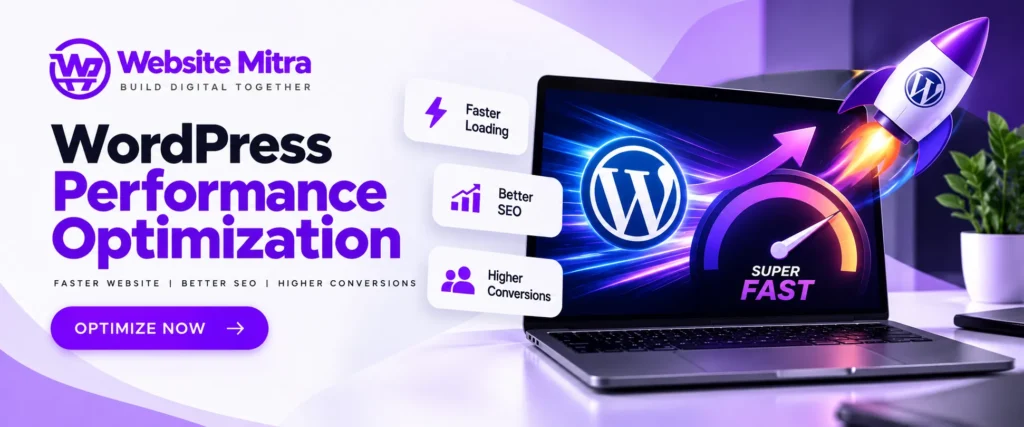
A fast WordPress website is essential for delivering a smooth user experience, supporting conversions and maintaining a technically healthy website.
WordPress performance optimization India involves identifying and fixing the technical factors that make a website slow, inefficient or difficult to interact with. These factors can include hosting, server response time, caching, images, CSS, JavaScript, plugins, themes, databases, fonts, third-party scripts and CDN configuration.
A professional WordPress performance optimization process should not focus exclusively on achieving a high score in one testing tool. It should improve the website’s real-world performance while preserving its design, functionality, SEO and business features.
Important optimization areas include:
- WordPress speed audit
- Core Web Vitals
- Hosting and server optimization
- Page caching
- Browser caching
- Object caching
- Image compression
- WebP/AVIF images
- CSS optimization
- JavaScript optimization
- Database optimization
- Plugin and theme optimization
- CDN configuration
- Mobile performance
- WooCommerce optimization
- Third-party script optimization
- Font optimization
- Technical SEO
- Performance monitoring
Google recommends achieving good Core Web Vitals for a strong user experience and Search performance, while also emphasizing that Core Web Vitals are only one part of the broader page-experience picture.
For businesses looking for professional website performance analysis, WebsiteMitra currently offers website audits that evaluate performance, Core Web Vitals, caching, server response time, image optimization and loading performance.
Introduction
Your WordPress website can have an attractive design, excellent content and strong SEO—but if it is slow, visitors may still struggle to use it.
A visitor clicking a service page expects the content to appear quickly. Someone browsing an online store expects product pages to respond smoothly. A potential customer filling out a contact form expects buttons and fields to work without delay.
When a website becomes slow, the problem is not always obvious.
Sometimes the hosting server is overloaded.
Sometimes a 4 MB hero image is responsible for unnecessary page weight.
Sometimes dozens of plugins are loading CSS and JavaScript on every page.
Sometimes the theme or page builder generates excessive markup.
In other cases, the website may have acceptable loading performance but poor interaction responsiveness because of heavy JavaScript.
This is why professional WordPress performance optimization in India should begin with diagnosis rather than randomly installing optimization plugins.
Google describes Core Web Vitals as real-world metrics covering loading performance, interactivity and visual stability. Its current Core Web Vitals are LCP, INP and CLS.
The objective should therefore be simple:
Make the WordPress website faster, more stable, easier to use and more efficient without breaking important functionality.
What Is WordPress Performance Optimization?
WordPress performance optimization is the process of improving the technical components that affect website loading, rendering, responsiveness and resource usage.
A WordPress website consists of many interconnected layers:
User → DNS → CDN → Server → WordPress → Theme → Plugins → Database → Assets → Browser
A problem at any of these levels can affect performance.
For example:
Hosting problem
The server takes too long to respond.
Image problem
Large images increase page weight.
Plugin problem
A plugin loads unnecessary scripts throughout the website.
Theme problem
The theme contains excessive CSS or JavaScript.
Database problem
Queries or autoloaded data slow down WordPress.
JavaScript problem
Large scripts delay interaction.
Caching problem
The website generates the same content repeatedly instead of serving cached resources.
Therefore, optimization needs to consider the complete WordPress environment.
Why Is WordPress Performance Important?
Website performance matters for both visitors and businesses.
A faster website can provide:
- Better user experience
- Faster page navigation
- Smoother interactions
- Better mobile usability
- More efficient server resource usage
- Improved Core Web Vitals
- Lower friction during conversions
- Better ecommerce browsing
- A stronger technical foundation
Google’s Search guidance recommends considering the overall page experience instead of focusing on only one performance metric. It specifically highlights good Core Web Vitals, secure delivery, mobile presentation and avoiding intrusive experiences as important aspects of page experience.
Performance is also connected to SEO, but it is important to avoid an exaggerated claim: optimizing speed does not automatically guarantee higher Google rankings.
Google states that its systems prioritize relevant, helpful content and that good page experience does not replace content relevance.
Therefore, performance optimization should be treated as an important part of a broader SEO, UX and website-development strategy.
Core Web Vitals and WordPress Performance
One of the most important parts of modern WordPress performance optimization is Core Web Vitals.
There are three current Core Web Vitals.
1. Largest Contentful Paint — LCP
LCP measures loading performance.
Google recommends an LCP of 2.5 seconds or less for a good user experience.
Poor LCP can be caused by:
- Slow hosting
- Slow server response
- Large hero images
- Render-blocking CSS
- Unoptimized fonts
- Excessive JavaScript
- Poor caching
- CDN configuration issues
For WordPress websites, the largest visible element is frequently a hero image, heading section or large content block.
Optimizing that element can have a significant impact on loading performance.
2. Interaction to Next Paint — INP
INP measures how quickly a page responds to user interactions.
Google currently recommends an INP below 200 milliseconds for good responsiveness.
A website can appear visually loaded while still feeling slow because JavaScript is blocking interaction.
Possible causes include:
- Heavy JavaScript
- Page builders
- Large plugins
- Third-party tracking
- Complex animations
- Excessive DOM processing
- Long-running scripts
Improving INP may require deeper JavaScript analysis rather than simply compressing files.
3. Cumulative Layout Shift — CLS
CLS measures visual stability.
Google recommends a CLS score below 0.1 for a good experience.
A page has poor visual stability when content unexpectedly moves while loading.
For example:
- An image appears without reserved dimensions
- A font loads and changes text size
- An advertisement pushes content downward
- A popup changes the layout
- A dynamic component appears late
WordPress performance optimization should therefore address both speed and stability.
Major Areas of WordPress Performance Optimization
1. WordPress Performance Audit
A professional optimization project should begin with an audit.
The audit should identify:
- Slow pages
- Slow server response
- Large files
- Excessive requests
- Heavy JavaScript
- Render-blocking resources
- Poor caching
- Large images
- Plugin bloat
- Theme problems
- Database issues
- Core Web Vitals problems
- Mobile performance problems
WebsiteMitra’s current website audit service specifically lists page speed, Core Web Vitals, caching, server response time, image optimization and loading performance among its performance checks.
This diagnostic stage is important because optimization without diagnosis can waste time.
2. Hosting and Server Optimization
Your hosting environment has a major influence on WordPress performance.
A website can have perfectly optimized images and still feel slow if the server is underpowered.
Important server factors include:
- CPU resources
- RAM
- PHP version
- Database performance
- Storage
- Server software
- Network latency
- Server load
- Object caching
- Server-side caching
For high-traffic websites, upgrading hosting may be necessary.
For smaller websites, configuration improvements may be enough.
The correct solution depends on the bottleneck.
3. Page Caching
Caching is one of the most common WordPress performance techniques.
Without caching, WordPress may repeatedly process PHP code and database requests to generate pages.
Caching can allow frequently requested pages to be served more efficiently.
Common caching types include:
Page cache
Stores generated page output.
Browser cache
Allows browsers to reuse previously downloaded resources.
Object cache
Stores frequently accessed database information.
Server cache
Operates at the infrastructure level.
Caching should be configured carefully because dynamic pages such as shopping carts, checkout pages and account pages may require special treatment.
4. Image Optimization
Images frequently contribute significantly to webpage size.
Common problems include:
- 3–5 MB images
- Incorrect dimensions
- PNG files used unnecessarily
- Uncompressed screenshots
- Large background images
- Multiple image versions
- Poor mobile image delivery
Image optimization can involve:
- Compression
- Resizing
- Responsive images
- WebP
- AVIF where appropriate
- Lazy loading
- Correct width and height
- Removing unnecessary images
WebsiteMitra’s audit documentation specifically identifies image optimization as part of its performance analysis.
5. CSS Optimization
CSS can become heavy when a WordPress website uses:
- Large page builders
- Multiple themes/plugins
- Animation libraries
- Multiple design frameworks
- Unused styles
CSS optimization can involve:
- Minification
- Removing unused CSS
- Critical CSS
- Combining or restructuring styles where appropriate
- Conditional asset loading
- Removing duplicate styles
However, CSS optimization should always be tested because aggressive removal can cause layout problems.
6. JavaScript Optimization
JavaScript can affect both loading and responsiveness.
A WordPress website may load JavaScript from:
- WordPress core
- Themes
- Plugins
- Page builders
- Analytics
- Chat systems
- Social platforms
- Advertising systems
- CRM integrations
Optimization techniques include:
- Minification
- Deferring non-critical scripts
- Delaying third-party scripts
- Removing unused scripts
- Conditional loading
- Reducing JavaScript execution
- Replacing unnecessary functionality
This is particularly important for INP.
7. Plugin Optimization
WordPress plugins add functionality, but unnecessary plugins can increase complexity.
A performance audit should review:
- Plugins that are no longer needed
- Duplicate functionality
- Plugins loading assets globally
- Resource-intensive plugins
- Outdated plugins
- Plugins creating excessive database queries
- Plugins performing unnecessary background operations
WebsiteMitra’s current WordPress SEO content also identifies unoptimized images and bloated, unnecessary plugins among common causes of slow WordPress websites.
The goal is not to use the fewest possible plugins.
The goal is to use appropriate plugins that provide necessary functionality without unnecessary performance overhead.
8. Theme Optimization
Themes can affect the amount of:
- HTML
- CSS
- JavaScript
- Fonts
- Images
- External libraries
A poorly optimized theme may include features that your business does not use.
Theme optimization can include:
- Removing unnecessary resources
- Improving CSS delivery
- Optimizing templates
- Reducing JavaScript
- Improving responsive layouts
- Removing unused libraries
- Improving font loading
If the existing theme is fundamentally bloated, a custom or lightweight theme may sometimes provide a better long-term solution.
9. Database Optimization
WordPress websites continuously store information.
Over time, databases can accumulate:
- Post revisions
- Spam comments
- Expired transients
- Unused metadata
- Plugin data
- WooCommerce records
- Autoloaded options
Database optimization can include:
- Cleaning unnecessary records
- Reviewing autoloaded options
- Optimizing tables
- Investigating slow queries
- Removing obsolete plugin data where safe
Database optimization is particularly important for older WordPress websites and large WooCommerce installations.
10. CDN Optimization
A Content Delivery Network can distribute static website assets through geographically distributed infrastructure.
This can help deliver resources such as:
- Images
- CSS
- JavaScript
- Fonts
- Other static files
A CDN can be especially useful when visitors are geographically distributed.
However, simply activating a CDN does not automatically solve every performance problem. CDN configuration, cache rules, DNS and origin-server performance still matter.
11. Mobile Performance Optimization
Mobile performance should be a major part of any WordPress optimization project.
A mobile visitor may have:
- A slower network
- A less powerful device
- Limited bandwidth
- A smaller viewport
The same page can therefore behave differently on mobile and desktop.
Mobile optimization may include:
- Responsive images
- Smaller assets
- Reduced JavaScript
- Optimized fonts
- Better caching
- Simplified layouts
- Reduced third-party resources
- Efficient mobile navigation
Google’s technical guidance emphasizes the importance of mobile-friendly experiences and fast pages.
12. Font Optimization
Typography can also affect performance.
Common font problems include:
- Too many font families
- Too many weights
- External font requests
- Incorrect loading behavior
- Font-induced layout shifts
Optimization may involve:
- Reducing font weights
- Hosting fonts locally where appropriate
- Preloading critical fonts
- Using modern font formats
- Applying suitable
font-display
This can improve both loading and visual stability.
13. Third-Party Script Optimization
Many websites depend on external services.
Examples include:
- Google Analytics
- Advertising platforms
- Chat widgets
- CRM software
- Heatmaps
- Social media widgets
- Reviews
- Marketing automation
Every external script has the potential to add network requests and JavaScript execution.
A performance audit should identify whether each script is:
- Essential
- Optional
- Delayed
- Loaded conditionally
- Replaceable
- Unnecessary
14. WooCommerce Performance Optimization
WooCommerce requires additional attention because ecommerce websites often contain dynamic functionality.
Optimization may involve:
- Product image optimization
- Product archive performance
- Database optimization
- Cart performance
- Checkout performance
- AJAX requests
- Product filters
- Payment integrations
- Shipping integrations
- Dynamic caching
Caching must be carefully configured around personalized pages.
For larger stores, database queries and hosting resources can become particularly important.
WordPress Performance Optimization for Different Businesses
Small Business Websites
Focus on:
- Hosting
- Caching
- Images
- Plugins
- Theme
- Mobile performance
Corporate Websites
Focus on:
- Performance
- Security
- CDN
- Technical SEO
- Large media
- Third-party scripts
Blogs
Focus on:
- Images
- Content delivery
- Caching
- Database
- Related-post functionality
Ecommerce Websites
Focus on:
- Product images
- Database
- Cart
- Checkout
- Dynamic caching
- Hosting
High-Traffic Websites
Focus on:
- Infrastructure
- CDN
- Object caching
- Database performance
- Server scaling
- Monitoring
WordPress Performance Optimization Process
A structured workflow is safer than making random changes.
Step 1: Initial Audit
Measure:
- Page speed
- Core Web Vitals
- Server response
- Page size
- Requests
- JavaScript
- CSS
- Images
- Plugins
Step 2: Backup
Create a reliable backup before making significant technical changes.
Step 3: Staging Environment
Where possible, test major changes in staging before applying them to production.
Step 4: Fix High-Impact Problems
Prioritize issues such as:
- Slow server
- Large images
- Missing caching
- Heavy JavaScript
- Plugin bloat
Step 5: Optimize Assets
Optimize:
- CSS
- JavaScript
- Images
- Fonts
Step 6: Optimize WordPress
Review:
- Plugins
- Theme
- Database
- WordPress configuration
Step 7: CDN and Caching
Configure appropriate caching and content delivery.
Step 8: Mobile Testing
Test important pages on mobile.
Step 9: Functional Testing
Check:
- Forms
- Menus
- Search
- Login
- Checkout
- Popups
- Sliders
- Tracking
Step 10: Post-Optimization Testing
Compare results before and after optimization.
How to Measure WordPress Performance
No single tool tells you everything.
Useful tools include:
Google PageSpeed Insights
Useful for performance recommendations and Core Web Vitals.
Lighthouse
Useful for performance and technical audits.
Google Search Console
Useful for monitoring real-world Core Web Vitals data.
GTmetrix
Useful for waterfall and resource analysis.
Query Monitor
Useful for WordPress-specific database and PHP investigation.
Browser Developer Tools
Useful for network requests, JavaScript and rendering analysis.
Google recommends using tools such as PageSpeed Insights and Search Console when evaluating page performance and Core Web Vitals.
WordPress Performance Optimization and SEO
Performance and SEO are closely connected, but they are not the same thing.
A technically excellent website still needs:
- Useful content
- Search intent alignment
- Proper internal linking
- Crawlable pages
- Appropriate metadata
- Strong information architecture
- Quality backlinks where appropriate
- Search-friendly URLs
- Structured data where applicable
Google’s Search Essentials emphasize helpful, reliable, people-first content alongside technical requirements and other SEO best practices.
Therefore:
Performance optimization + technical SEO + useful content + good UX = stronger overall website foundation.
Common WordPress Performance Mistakes
Installing Too Many Optimization Plugins
More optimization plugins do not necessarily mean better performance.
Using Multiple Caching Systems
Conflicting cache configurations can create unexpected behavior.
Compressing Images Without Resizing Them
A 4000-pixel image may remain unnecessarily large even after compression.
Delaying Everything
Aggressively delaying JavaScript can break functionality.
Ignoring Hosting
Plugin optimization cannot fully compensate for severely inadequate infrastructure.
Optimizing Only the Homepage
A website may have a fast homepage but slow product, service or blog pages.
Ignoring Mobile
Desktop performance does not represent every user’s experience.
Chasing a Perfect Score
A 100 score in a laboratory test is not the only objective. Google recommends evaluating overall page experience and notes that Core Web Vitals alone do not guarantee high rankings.
How Much Does WordPress Performance Optimization Cost in India?
There is no single price for WordPress performance optimization.
The cost depends on:
- Website size
- Number of pages
- Hosting
- Number of plugins
- Theme complexity
- WooCommerce functionality
- Database size
- Traffic
- Server configuration
- Required coding changes
- CDN requirements
- Performance targets
A simple business website may require basic optimization, while a large ecommerce website may require server, database, code and infrastructure work.
WebsiteMitra currently offers website audit packages starting at ₹2,999 for a Starter Audit and ₹7,999 for its Professional Audit package. The published scope includes performance/Core Web Vitals assessment and, for the professional package, broader technical SEO, security and conversion analysis.
A business should therefore compare providers based on the actual scope of diagnosis and implementation, rather than choosing only by the lowest price.
How to Choose a WordPress Performance Optimization Company in India
Before hiring a provider, ask these questions:
Do they perform an audit first?
A proper diagnosis should come before optimization.
Do they understand Core Web Vitals?
They should be able to explain LCP, INP and CLS.
Do they check hosting?
Server performance is often overlooked.
Do they optimize images?
Images can be a major contributor to page weight.
Do they audit plugins?
Plugin performance should be evaluated rather than assuming every plugin is problematic.
Do they understand WooCommerce?
Stores require special attention to dynamic functionality.
Do they test mobile?
Mobile performance should be included.
Do they provide before-and-after measurements?
Performance work should be measurable.
Do they test website functionality?
Optimization should not break the website.
Why Choose WebsiteMitra for WordPress Performance Optimization?
WebsiteMitra’s current website audit offering is built around a broader website-health assessment rather than performance alone.
Its published performance audit scope includes:
- Page speed
- Core Web Vitals
- Caching
- Server response time
- Image optimization
- Loading performance
- Mobile responsiveness
- Technical website issues
WebsiteMitra also provides related WordPress services, including website development, technical SEO, custom WordPress development, plugin development and WooCommerce-related development.
This can be useful when performance issues are connected to deeper development problems rather than simple configuration issues.
For example, a website might need a custom-coded solution instead of another plugin. In other situations, a theme or plugin may need technical modification.
WordPress Performance Optimization Checklist
Use the following checklist as a starting point.
Hosting
- Reliable hosting
- Adequate CPU
- Adequate RAM
- Modern PHP
- Efficient database
Caching
- Page caching
- Browser caching
- Object caching where appropriate
- Server-side caching where available
Images
- Compress images
- Resize images
- Use responsive images
- Use WebP/AVIF where appropriate
- Lazy-load suitable images
CSS
- Minify CSS
- Remove unnecessary CSS
- Optimize critical CSS
- Reduce render-blocking resources
JavaScript
- Minify scripts
- Defer non-critical scripts
- Delay unnecessary third-party scripts
- Remove unused scripts
WordPress
- Remove unnecessary plugins
- Update WordPress
- Update plugins
- Update themes
- Review theme performance
Database
- Clean unnecessary revisions
- Review transients
- Check autoloaded options
- Optimize tables
- Investigate slow queries
Mobile
- Test mobile pages
- Optimize images
- Reduce JavaScript
- Test menus
- Test forms
Core Web Vitals
- LCP ≤ 2.5 seconds
- INP < 200 milliseconds
- CLS < 0.1
These thresholds correspond to Google’s current guidance for good Core Web Vitals.
Frequently Asked Questions
1. What is WordPress performance optimization?
WordPress performance optimization is the process of improving the loading speed, responsiveness, stability and resource efficiency of a WordPress website.
2. Why is my WordPress website slow?
Common causes include slow hosting, large images, excessive plugins, inefficient themes, JavaScript, CSS, database problems, third-party scripts and poor caching.
3. Does WordPress performance affect SEO?
Performance and page experience are relevant to Google’s Search systems, particularly through Core Web Vitals and related page-experience considerations. However, performance optimization alone does not guarantee higher rankings.
4. What are Core Web Vitals?
Core Web Vitals are Google’s user-experience metrics covering loading performance, responsiveness and visual stability. The current metrics are LCP, INP and CLS.
5. What is a good LCP score?
Google recommends an LCP of 2.5 seconds or less for a good user experience.
6. What is a good INP score?
Google recommends an INP below 200 milliseconds for a good user experience.
7. What is a good CLS score?
Google recommends a CLS score below 0.1 for a good user experience.
8. Is a caching plugin enough to make WordPress fast?
Not necessarily. Caching is useful, but performance can also depend on hosting, images, JavaScript, CSS, plugins, themes, databases and third-party services.
9. Can you optimize WooCommerce websites?
Yes. WooCommerce optimization may include product images, database performance, product pages, cart, checkout, AJAX functionality and dynamic caching.
10. Does changing hosting improve WordPress speed?
It can improve server response and available resources, but hosting is only one part of website performance.
11. How much does WordPress performance optimization cost in India?
Pricing depends on website complexity and the required work. WebsiteMitra currently lists website audit packages at ₹2,999 and ₹7,999, with different levels of performance, SEO, security and conversion analysis.
12. How long does WordPress optimization take?
The time depends on the website’s size, number of issues, hosting, plugins, theme, database and required development work.
13. Can performance optimization break my website?
Poorly configured optimization can break functionality. Major changes should therefore be backed up, tested and verified before being deployed.
14. Should I remove all WordPress plugins?
No. Plugins should be evaluated based on their purpose, quality and performance impact. Unnecessary or duplicate plugins can be removed where appropriate.
15. Should I optimize desktop or mobile first?
Both should be tested. Mobile deserves particular attention because device and network conditions can differ significantly from desktop environments.
16. Is WordPress performance optimization a one-time process?
Some improvements are one-time, but ongoing monitoring is useful because new plugins, content, integrations and updates can introduce new performance issues.
17. Does a PageSpeed score of 100 guarantee good SEO?
No. Google explains that Core Web Vitals and page experience are only part of the overall Search system. Relevant, helpful content remains important.
18. Can WebsiteMitra audit my website performance?
Yes. WebsiteMitra currently offers website health audits that include performance and Core Web Vitals analysis, including page speed, caching, server response and image optimization.
Conclusion
WordPress performance optimization India is not simply about making a website’s PageSpeed score look better.
It is about creating a website that loads efficiently, responds smoothly, remains visually stable and uses server resources intelligently.
A comprehensive optimization strategy can include:
Audit → Hosting → Caching → Images → CSS → JavaScript → Plugins → Theme → Database → CDN → Mobile → Core Web Vitals → Testing
The right optimization strategy depends on the individual website.
A small business website may primarily need image optimization and caching.
A large WooCommerce store may require database, server, query and dynamic-content optimization.
A JavaScript-heavy website may need deeper frontend optimization.
A website with poor server response may need infrastructure changes.
This is why diagnosis should come before optimization.
WebsiteMitra’s current website audit service evaluates performance, Core Web Vitals, caching, server response time, image optimization and loading performance, while its broader audit offering also covers technical SEO, security, mobile responsiveness and other website-health factors.
If your WordPress website is slow, start with a proper performance audit and identify the actual bottleneck before making major changes.
Need WordPress Performance Optimization?
Get your WordPress website analyzed by WebsiteMitra and identify the technical issues affecting speed, Core Web Vitals and user experience.